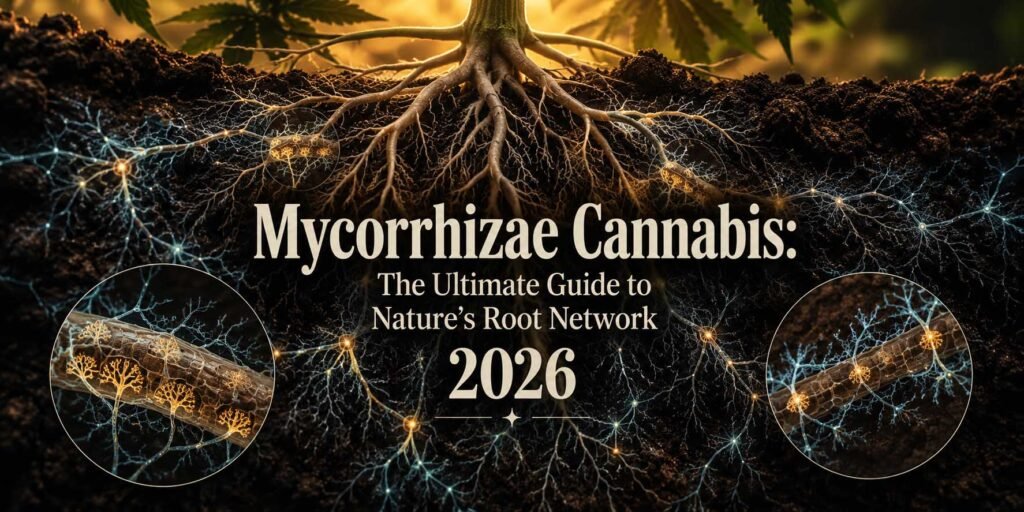
Beneath every thriving cannabis plant in the Space Trees grow room — invisible to the naked eye but fundamental to everything we produce — is one of the most extraordinary biological systems in nature. Mycorrhizae cannabis cultivation harnesses a symbiotic relationship between plants and fungi that has existed for over 400 million years, predating the dinosaurs and forming the biological foundation of almost every terrestrial ecosystem on earth.
Mycorrhizal fungi are not a supplement or an additive. In a living soil environment they are an essential living infrastructure — extending the cannabis plant’s root system by up to 700 times its natural reach, delivering phosphorus, micronutrients, and water through biological pathways that no synthetic nutrient solution can replicate. They are the primary reason why mycorrhizae cannabis grown in living soil smells more complex, expresses more vivid terpene profiles, and produces a measurably superior final product to conventionally grown equivalents.
This complete guide covers the full science of mycorrhizae cannabis cultivation — what mycorrhizal fungi are, how they work, their specific benefits for cannabis, what destroys them, and how Space Trees integrates them into our living soil programme in Chiang Mai.
Table of Contents
- What Is Mycorrhizae?
- Types of Mycorrhizal Fungi for Cannabis
- How Mycorrhizal Networks Form
- The 7 Benefits of Mycorrhizae for Cannabis
- Mycorrhizae and Cannabis Terpene Production
- How to Apply Mycorrhizae in Cannabis Cultivation
- What Kills Mycorrhizal Networks
- Mycorrhizae vs Synthetic Nutrients
- Mycorrhizae at Space Trees Thailand
- FAQ
What Is Mycorrhizae?
Mycorrhizae (from the Greek mykes — fungus, and rhiza — root) describes the symbiotic association between specialised soil fungi and the root systems of plants. The term encompasses both the fungi themselves and the relationship they form with the plant — a relationship so ancient and so fundamental that approximately 90% of all land plant species on earth form mycorrhizal associations.
In the context of mycorrhizae cannabis cultivation, this association works as follows: mycorrhizal fungi colonise the cannabis plant’s root surface and often penetrate root cells directly, forming an intimate biological interface. In exchange for carbohydrates and sugars produced by the plant through photosynthesis, the fungi extend a vast network of microscopic filaments — called hyphae — far beyond the reach of the plant’s own roots into the surrounding soil. These hyphae explore, mine, and deliver soil resources back to the plant at a scale and efficiency that the plant’s root system alone cannot approach.
This exchange is not parasitic — it is genuinely mutualistic. The plant feeds the fungi and the fungi feed the plant. Both organisms thrive more completely in the presence of the other than either would alone.
Types of Mycorrhizal Fungi for Cannabis
Two broad categories of mycorrhizal fungi are relevant to mycorrhizae cannabis cultivation, each with distinct characteristics and benefits:
Arbuscular Mycorrhizal Fungi (AMF)
The most important and most widely used mycorrhizal type for cannabis cultivation. AMF — also called endomycorrhizae — penetrate the root cells of the cannabis plant, forming highly efficient nutrient-exchange structures called arbuscules inside the root tissue. This intimate cellular interface makes AMF the most effective mycorrhizal type for phosphorus delivery — the nutrient cannabis requires in highest quantity during flowering.
Key AMF species relevant to mycorrhizae cannabis cultivation include:
- Rhizophagus irregularis (formerly Glomus intraradices) — the most studied and most widely available AMF species
- Glomus mosseae — strong phosphorus mobilisation, good drought tolerance
- Glomus aggregatum — excellent in organic soil environments
- Paraglomus occultum — beneficial in phosphorus-limited soils
Ectomycorrhizal Fungi (EMF)
EMF form their interface outside root cells rather than inside, surrounding the root with a sheath of fungal tissue called a Hartig net. While EMF are the dominant mycorrhizal type in forest ecosystems — and play a significant role in living soil environments — they are less directly relevant to cannabis root colonisation than AMF. However, in a well-established living soil ecosystem, ectomycorrhizal species contribute meaningfully to the overall soil biology that supports mycorrhizae cannabis cultivation.
Trichoderma — the Mycorrhizal Partner
While not technically mycorrhizal fungi, Trichoderma species frequently appear alongside mycorrhizal inoculants and play an important complementary role in mycorrhizae cannabis grows. Trichoderma enhances root development, suppresses soil-borne pathogens, and has been shown to actively stimulate mycorrhizal colonisation. Most quality mycorrhizal inoculant products for cannabis include Trichoderma alongside AMF species.
How Mycorrhizal Networks Form
Understanding how mycorrhizae cannabis associations develop explains why growing conditions and substrate choices matter so much.
Stage 1 — Recognition
Mycorrhizal spores in the soil detect chemical signals — strigolactones — released by the cannabis root. These compounds, also involved in branching regulation, act as a homing signal that directs fungal hyphal growth toward the root.
Stage 2 — Contact and Penetration
Hyphae make contact with the root surface and begin the colonisation process. For AMF, this involves penetrating the root epidermis and cortex cells to form the arbuscule — the nutrient exchange interface. This process requires chemical signalling from the plant that essentially gives the fungus permission to enter — a controlled, cooperative process rather than an invasion.
Stage 3 — Network Development
Once established within the root, the fungus extends its external hyphal network — the extraradical mycelium — outward into the surrounding soil. This network can extend 25–50cm from the root surface, exploring soil volumes the root itself never reaches. In an established living soil bed, these networks interconnect with the hyphae of other plants, creating the mycorrhizal network — sometimes called the Wood Wide Web — that allows resource sharing between plants in the same soil ecosystem.
Stage 4 — Nutrient Exchange
The mature mycorrhizal network operates as a biological supply chain. Phosphorus, nitrogen, zinc, copper, and other micronutrients are captured by the hyphal tips at the network’s outer reaches and transported back to the arbuscule interface, where they are delivered to the plant in exchange for carbon. This exchange is continuous and self-regulating — the plant allocates more carbon to fungal partners that deliver more nutrients.
The 7 Benefits of Mycorrhizae for Cannabis
1. Massively Extended Nutrient Access
The most quantifiable benefit of mycorrhizae cannabis cultivation is the extraordinary expansion of effective root surface area. Mycorrhizal hyphae are 50–100 times thinner than root hairs, allowing them to access soil pores and mineral surfaces that roots cannot reach. The effective nutrient-gathering surface of a mycorrhizal root system can be up to 700 times larger than the root alone — delivering phosphorus, nitrogen, zinc, copper, manganese, and other micronutrients at a scale and efficiency that no synthetic nutrient programme can replicate.
2. Phosphorus Delivery — The Cannabis Flowering Essential
Phosphorus is the nutrient cannabis requires in greatest quantity during flowering — essential for bud development, resin production, and trichome density. Phosphorus is also one of the most immobile nutrients in soil, meaning it cannot easily reach roots even when present in adequate quantities. AMF specialise in phosphorus mobilisation — their hyphae can access and deliver phosphorus from soil pools unavailable to uncolonised roots, making them essential for optimal flowering performance in mycorrhizae cannabis cultivation.
3. Superior Drought and Water Stress Resilience
The hyphal network of mycorrhizal fungi has a significantly greater surface-area-to-volume ratio than roots, making it exceptionally efficient at water absorption from soil micropores. Mycorrhizae cannabis plants consistently demonstrate superior performance under drought conditions and recover faster from water stress than uncolonised plants. In Chiang Mai’s hot season, this resilience is practically significant.
4. Disease Resistance and Root Protection
Mycorrhizal colonisation provides multiple layers of protection against root pathogens. Physically, the hyphal sheath around colonised roots creates a barrier that pathogens must penetrate before reaching root tissue. Biochemically, mycorrhizal fungi produce compounds that suppress pathogenic organisms including Fusarium, Pythium, and Rhizoctonia — some of the most damaging cannabis root pathogens. In a well-established mycorrhizae cannabis living soil system, this biological protection reduces the need for any chemical intervention at the root zone.
5. Soil Structure and Aeration
Mycorrhizal hyphae produce a glycoprotein called glomalin — a sticky, carbon-rich compound that binds soil particles together into aggregates. This aggregation improves soil structure, creating the air pockets and drainage channels that cannabis roots require. Glomalin production by AMF is one of the primary mechanisms through which mycorrhizae cannabis cultivation improves long-term soil health with each successive grow cycle.
6. Enhanced Nutrient Cycling and Microbial Community
Mycorrhizal networks do not operate in isolation — they interact with and stimulate a broader community of beneficial soil organisms. Mycorrhizosphere — the zone of soil influenced by mycorrhizal activity — has consistently higher bacterial diversity and activity than non-mycorrhizal soil. This enhanced microbial community accelerates organic matter decomposition, nitrogen cycling, and the overall biological activity that defines a truly living soil.
7. Stress Recovery and Resilience
Mycorrhizae cannabis plants recover faster from transplant shock, heat stress, overwatering, and other cultivation stressors. The mycorrhizal network acts as a buffer — maintaining nutrient and water supply to the plant even when the root system itself is temporarily compromised. This resilience is particularly valuable during the vulnerable transplant stage and in grow rooms where environmental conditions may fluctuate.
Mycorrhizae and Cannabis Terpene Production
The connection between mycorrhizae cannabis cultivation and terpene expression is one of the most significant and least discussed aspects of mycorrhizal science — and it is the most directly relevant to the quality difference you experience when opening a Space Trees jar.
Terpene biosynthesis in cannabis requires specific micronutrients — particularly zinc and manganese — as enzymatic cofactors in the mevalonate pathway through which terpenes are synthesised. Zinc and manganese are among the nutrients most efficiently delivered by mycorrhizal networks, accessing soil pools unavailable to uncolonised roots.
Research consistently shows that mycorrhizae cannabis plants produce measurably higher terpene content than uncolonised equivalents grown in the same soil — with the difference particularly pronounced in secondary and tertiary terpene compounds that contribute to profile complexity rather than just dominant notes.
This is the scientific explanation for why living soil grown cannabis smells more complex and more expressive than hydroponically grown equivalents. It is not just the growing medium — it is the mycorrhizal network within that medium delivering the micronutrients that make complex terpene synthesis possible.
For the full terpene science: Cannabis Terpenes: The Ultimate Guide
How to Apply Mycorrhizae in Cannabis Cultivation
For growers integrating mycorrhizae cannabis cultivation into their programme, application timing and method determine colonisation success.
Application Methods
Root Dip at Transplant The most effective application method for established plants. Mix mycorrhizal inoculant into water at the recommended rate and soak the root ball for 15–30 minutes before transplanting. Direct contact between the inoculant and root surface maximises colonisation success.
In-Hole Application Place mycorrhizal inoculant directly into the planting hole at the base before transplanting. As roots grow downward they make direct contact with the inoculant.
Seed Coating For seed germination, mix mycorrhizal inoculant with water and coat seeds before planting. The fungal spores colonise the emerging radicle as germination occurs.
Top-Dress and Water In Less effective than direct root contact methods but suitable for established plants. Apply inoculant to the soil surface and water thoroughly to move spores toward the root zone.
Application Rates
Follow manufacturer guidance on inoculant products. Generally:
- Transplant root dip: 5–10g per litre of water
- In-hole application: 5–15g per planting site depending on plant size
- Living soil initial build: 25–50g per cubic foot of soil medium
Timing
Mycorrhizae cannabis colonisation is most effective when introduced at the earliest possible stage — seedling or clone immediately after rooting. The younger the root system, the more completely and rapidly mycorrhizal colonisation occurs. Introducing mycorrhizal inoculants to mature, established plants produces less dramatic colonisation than early-stage introduction.
What Kills Mycorrhizal Networks
Understanding what destroys mycorrhizae cannabis networks is as important as knowing their benefits — because several common growing practices are directly incompatible with mycorrhizal cultivation.
Synthetic Phosphorus Fertilisers
This is the most common and most damaging enemy of mycorrhizae cannabis networks. When soluble phosphorus is abundant in the root zone, the cannabis plant has no biological need for mycorrhizal phosphorus delivery and actively suppresses colonisation. High-phosphate synthetic nutrient solutions — used in virtually all hydroponic growing — prevent meaningful mycorrhizal association. This is why mycorrhizal inoculants are ineffective in conventional synthetic growing programmes.
Fungicides
Any fungicide — systemic or contact — poses significant risk to mycorrhizal networks. Mycorrhizal fungi are fungi. Fungicidal applications that target pathogens do not discriminate between harmful and beneficial fungal species. This is a critical consideration in cannabis IPM — any fungicide application in a mycorrhizae cannabis living soil system requires careful product selection and targeted application to avoid collateral mycorrhizal damage.
For the full cannabis IPM perspective: Cannabis IPM: The Complete Guide
Soil Tillage
Aggressive tillage — turning, mixing, or disrupting the soil — physically destroys the hyphal networks that mycorrhizal colonies depend on. This is one of the primary arguments for no-till living soil cultivation, where the soil structure is preserved between grow cycles and mycorrhizal networks can develop and strengthen over successive generations.
Sterilised and Pasteurised Media
Sterile growing media — sterilised coco coir, pasteurised potting mixes, rockwool, and all hydroponic media — contain no viable mycorrhizal spores. Mycorrhizae cannabis cultivation requires living, biologically active growing media. This is why mycorrhizal inoculants must be introduced actively in any sterile-media grow.
Extreme pH
Mycorrhizal fungi operate optimally in the same pH range that cannabis prefers — 6.0–7.0. Highly acidic or alkaline conditions reduce colonisation efficiency. In living soil, maintaining appropriate pH through organic matter management and appropriate limestone applications protects both plant and mycorrhizal health simultaneously.
Mycorrhizae vs Synthetic Nutrients
The fundamental difference between mycorrhizae cannabis cultivation and synthetic nutrient growing is not just chemical — it is biological. This distinction matters enormously for the quality of the final product.
Synthetic nutrient cultivation:
- Delivers nutrients in soluble, immediately available form
- Bypasses the biological delivery system
- Actively suppresses mycorrhizal colonisation (particularly high phosphorus feeds)
- Produces consistent but often flavour-flat cannabis
- Maximises yield in the short term
- Degrades soil biology over time
Mycorrhizae cannabis living soil cultivation:
- Delivers nutrients through biological pathways at the plant’s own pace
- Supports and is supported by the full soil microbiome
- Produces measurably higher terpene complexity
- Builds soil quality over time rather than depleting it
- Requires longer establishment period but produces superior long-term results
- Cannot be combined with synthetic phosphorus or fungicides
The practical result of this difference is what you experience when you open a Space Trees jar — the aromatic complexity that makes our cannabis smell the way it does comes from a plant that received its nutrients through mycorrhizal biological pathways rather than synthetic solutions. You cannot replicate the living soil terpene expression without the mycorrhizal network that makes it possible.
Mycorrhizae at Space Trees Thailand
Mycorrhizae cannabis cultivation is not a marketing claim at Space Trees — it is the biological foundation of everything we grow. Our living soil beds in Chiang Mai have been cultivated over multiple grow cycles, with mycorrhizal networks developing and strengthening with each successive generation of plants.
When we introduce a new genetics batch — whether it is a pheno hunt run of Ethos Genetics, a new LIT Farms release, or the Wizard Trees RS-11 cut behind our Rainbow Marker — every plant is transplanted into living soil with established mycorrhizal networks waiting to colonise the new root system within days.
The result is plants that receive their full spectrum of micronutrients through biological delivery from the day of transplant — building the trichome density, terpene complexity, and cannabinoid expression that distinguishes Space Trees cannabis from anything grown in synthetic media.
Our cloning programme specifically accounts for mycorrhizae. Read more: Cannabis Cloning: The Complete Guide
Our IPM programme is designed to protect the mycorrhizal network as a primary biological asset. Read more: Cannabis IPM: The Complete Guide
And our living soil pillar article explains the full ecosystem that mycorrhizae are part of: What Is Living Soil Cannabis? The Complete Guide
Frequently Asked Questions
What is mycorrhizae and why does it matter for cannabis?
Mycorrhizae cannabis cultivation harnesses a symbiotic relationship between specialised soil fungi and cannabis roots. The fungi extend the plant’s effective root reach by up to 700 times, delivering phosphorus, micronutrients, and water through biological pathways that synthetic nutrients cannot replicate. The result is more complex terpene expression, better drought resilience, and superior soil health over time.
How long does mycorrhizae take to colonise cannabis roots?
Initial colonisation of cannabis roots by mycorrhizal fungi typically begins within 1–2 weeks of inoculation under optimal conditions. Visible growth benefits — improved vigour, darker foliage — are typically apparent within 3–4 weeks. Full colonisation and maximum network development takes 4–8 weeks in a well-established living soil environment.
Does mycorrhizae increase cannabis yield?
Yes — mycorrhizae cannabis cultivation consistently produces improved yields compared to uncolonised controls in comparable growing conditions. The primary mechanism is improved phosphorus delivery during flowering, which directly supports bud development and resin production. However the most significant benefit of mycorrhizae is terpene complexity rather than raw yield.
Can you use mycorrhizae with synthetic nutrients?
No — synthetic phosphorus fertilisers suppress mycorrhizal colonisation. The cannabis plant only allocates carbon to mycorrhizal partners when it needs the biological delivery system. When synthetic phosphorus makes the plant self-sufficient, it stops feeding the fungi. Mycorrhizae cannabis cultivation is incompatible with high-phosphate synthetic nutrient programmes.
What kills mycorrhizal networks in cannabis grows?
The primary threats to mycorrhizae cannabis networks are synthetic phosphorus fertilisers, fungicide applications, aggressive soil tillage, and extremely acidic or alkaline pH. In a living soil grow room, these practices should be avoided entirely to preserve the mycorrhizal network that drives the quality difference in the final product.
How do I apply mycorrhizae to cannabis plants?
The most effective application is a root dip at transplant — soaking the root ball in a mycorrhizal inoculant solution before planting. In-hole application — placing inoculant directly in the planting site — is also effective. For seedlings, seed coating before germination ensures colonisation from the first day of root development.
Does Space Trees use mycorrhizae in their grows?
Yes — mycorrhizal networks are a core component of the Space Trees living soil programme in Chiang Mai. Our soil beds have been cultivated over multiple grow cycles, with mycorrhizal networks building strength and density with each generation of plants. The terpene complexity our customers experience is a direct result of the mycorrhizal biological delivery system operating at full capacity in our established living soil environment.
Last updated: 2026 | Written by Sam Walker, Space Trees cultivation specialist. For educational purposes. Individual growing results vary depending on strain, environment, and soil health.