Cannabis cloning is one of the most powerful and fundamental techniques in modern cannabis cultivation — and one of the most misunderstood. The ability to take a cutting from a proven, high-performing plant and root it into an exact genetic replica is what allows serious growers to preserve elite phenotypes indefinitely, maintain consistent quality across every harvest, and scale production without sacrificing the genetic integrity that makes a particular cultivar exceptional.
At Space Trees Chiang Mai, cannabis cloning is a core part of our seed to sale, living soil operation. When we identify a phenotype that expresses everything we want — the right terpene profile, the right structure, the right resin production — we preserve it through cloning. This guide shares everything we know about the process, from mother plant selection through to successful transplant.
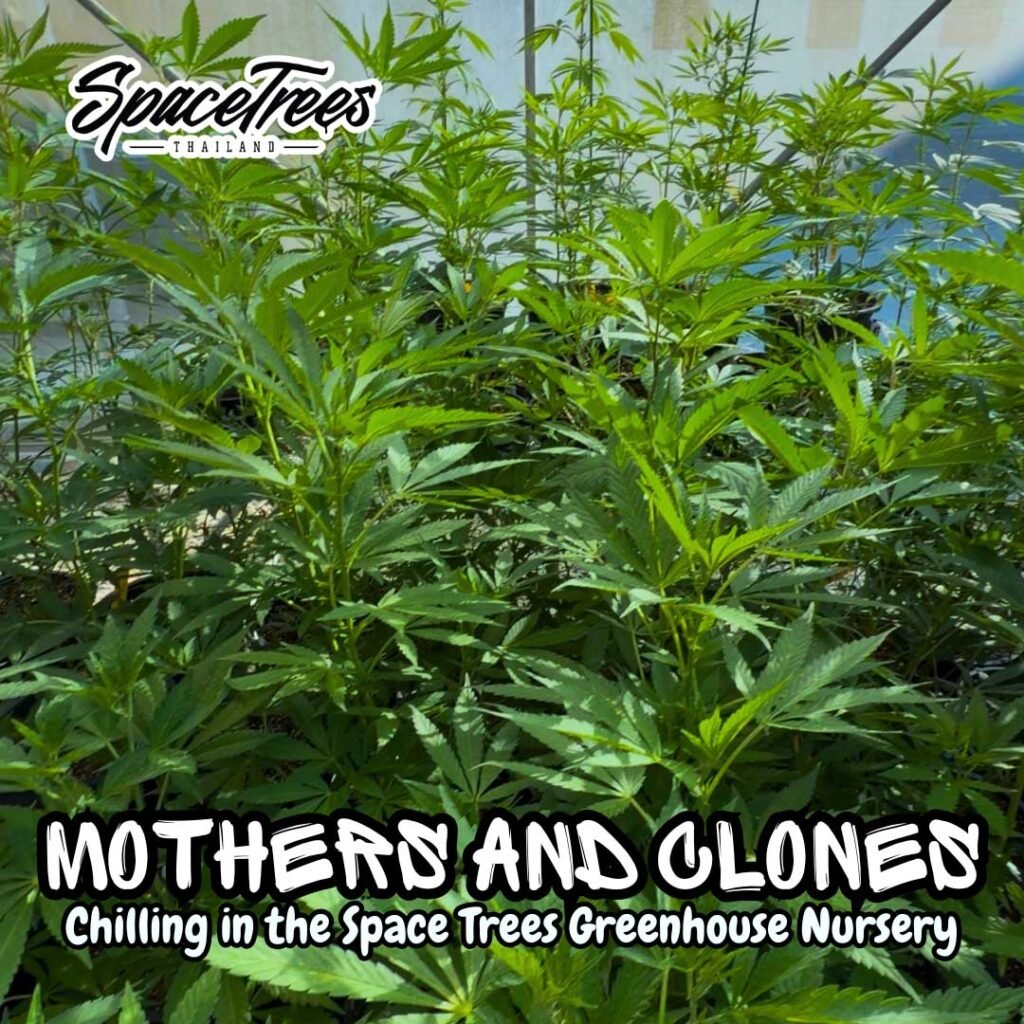
Table of Contents
- What Is Cannabis Cloning?
- Why Clone Instead of Growing from Seed?
- Selecting the Perfect Mother Plant
- Equipment and Preparation
- How to Take a Cannabis Clone — Step by Step
- Rooting Your Cuttings
- Cannabis Cloning in Living Soil
- Common Cloning Mistakes
- Cloning at Space Trees Thailand
- FAQ
What Is Cannabis Cloning?
Cannabis cloning is the process of taking a vegetative cutting from a healthy cannabis plant — known as the mother plant — and encouraging that cutting to develop its own root system. The resulting clone is a genetically identical copy of the mother, carrying the same cannabinoid profile, terpene expression, growth characteristics, and yield potential.
Unlike growing from seed — where genetic variation between plants is inevitable even within the same strain — cannabis cloning produces plants that are phenotypically consistent. Every clone from the same mother will grow the same way, smell the same way, and produce the same quality of flower. For commercial growers and serious craft cultivators, this predictability is not a convenience — it is a fundamental requirement.
Cannabis cloning has been practised commercially since the early days of indoor cultivation in the 1980s and remains the propagation method of choice for any operation where genetic consistency and quality control are the priority.
Why Clone Instead of Growing from Seed?
Cannabis cloning offers several significant advantages over seed-based cultivation:
Genetic Consistency Every clone is an exact genetic replica of the mother. When you find a phenotype that performs at the highest level — exceptional terpene expression, heavy resin production, ideal structure — cloning locks that genetics in place indefinitely. No variation. No surprises.
Time Efficiency Cannabis cloning bypasses the germination and seedling stages entirely. A rooted clone enters the vegetative phase immediately — saving 1–2 weeks compared to seed-grown plants and accelerating the production cycle.
Cost Efficiency Premium cannabis genetics — particularly single-run releases from breeders like Ethos Genetics, LIT Farms, and Doja Exclusive — can be expensive and difficult to source consistently. Cannabis cloning allows a single seed purchase to become a permanent, perpetually available genetic library.
Preservation of Elite Phenotypes Phenotype hunting — the process of growing multiple seeds and identifying the single best-performing individual — is how the finest cannabis cuts in the world are discovered. Once found, that exceptional phenotype can only be preserved through cannabis cloning. Without it, the cut is lost.
Predictable Flowering All clones from the same mother have the same biological age and respond identically to the flip to 12/12 light cycle. This produces uniform canopies, consistent finishing times, and harvests that are easier to manage and schedule.
Selecting the Perfect Mother Plant
The quality of every cannabis cloning programme begins with mother plant selection. The mother is the genetic foundation of everything that follows — and choosing the wrong one undermines every subsequent step.
What to look for in a mother plant:
Health and Vigour The mother should be in robust vegetative health — no signs of pest or disease pressure, no nutrient deficiency, no stress. Stressed plants produce stressed clones with compromised root development. Only clone from a plant that is thriving.
Terpene Expression Run your hands lightly along the stems — the resin transferred onto your fingers tells you exactly how expressive the plant’s terpene production is. A mother that smells extraordinary in veg will produce clones that smell extraordinary in flower.
Structure and Growth Pattern Look for lateral branching, internode spacing, and overall vigour. A mother with strong lateral branching produces more cloning sites and indicates robust genetic expression.
Known Performance History The best mother plants are those that have already proven themselves through a full grow cycle — with documented terpene profiles, yield data, and cannabinoid testing. At Space Trees, we only preserve mother plants from phenotypes that have been fully evaluated and selected for the menu.
Vegetative State Only Never take clones from a plant in flower. The hormonal state of a flowering plant produces clones that root slowly, express abnormal growth, and often never fully recover their vegetative vigour.
Equipment and Preparation
Successful cannabis cloning requires clean, prepared equipment and a stable environment. Contamination is the primary cause of clone failure — sterile conditions are non-negotiable.
Essential equipment:
- Sharp, sterile scalpel or razor blade — a clean cut is critical
- Rooting hormone — gel or powder, indole-3-butyric acid (IBA) based
- Rooting medium — rockwool cubes, peat pellets, or purpose-built clone plugs
- Humidity dome — to maintain 80–90% relative humidity during rooting
- Tray with drainage
- Spray bottle with clean, pH-adjusted water (5.8–6.2)
- Soft-spectrum propagation light — 18 hours on, 6 off
- Isopropyl alcohol for sterilising all cutting tools between plants
Environment targets during rooting:
- Temperature: 22–26°C
- Relative humidity: 80–90%
- Light: low-intensity, full spectrum, 18/6 cycle
- No direct root-zone feeding until roots establish
How to Take a Cannabis Clone — Step by Step
Follow this sequence for consistent cannabis cloning success:
Step 1 — Prepare your equipment Sterilise all cutting tools with isopropyl alcohol. Soak rockwool cubes or clone plugs in pH 5.8 water for 30 minutes. Prepare your rooting hormone.
Step 2 — Select your cutting site Identify a healthy branch on the mother plant with at least two nodes. The ideal cutting is 10–15cm (4–6 inches) long, taken from a lateral branch rather than the main stem.
Step 3 — Make the cut Using your sterilised blade, cut cleanly at a 45-degree angle just below a node. The angled cut increases the surface area available for root development. Make the cut in a single confident stroke — do not saw.
Step 4 — Immediate submersion Place the cut end immediately into a glass of pH-adjusted water. This prevents air bubbles from entering the stem and blocking the vascular tissue.
Step 5 — Strip lower leaves Remove all but the top two sets of leaves. Lower leaves in contact with the rooting medium create entry points for pathogens. Trim the remaining leaves by half to reduce transpiration stress while the clone has no roots to draw water from.
Step 6 — Apply rooting hormone Remove the cutting from water, gently shake off excess, and dip the cut end in rooting gel or powder — coating 1–2cm of the stem. Do not double-dip into the hormone container — pour a small amount into a separate dish to avoid contaminating your stock.
Step 7 — Insert into rooting medium Insert the hormone-coated stem into the centre of your prepared rockwool cube or clone plug to a depth of approximately 1–2cm. Firm gently around the base.
Step 8 — Into the humidity dome Place all cuttings in the humidity dome. Mist the interior lightly with pH-adjusted water and close. Do not water the rooting medium at this stage — moisture from the misting is sufficient.
Step 9 — Monitor and maintain Check daily. Mist the dome interior once or twice per day to maintain humidity. Do not open the dome unnecessarily — humidity fluctuation is one of the most common causes of cutting failure. After 5–7 days, begin introducing brief periods of ventilation to harden the cuttings gradually.
Rooting Your Cuttings
Rooting is the critical phase of cannabis cloning — the period between taking the cutting and transplanting the rooted clone into its grow medium.
Timeline:
- Days 1–3: Cutting establishes, may show minor wilting — this is normal
- Days 4–7: First signs of root nubs at the stem base in transparent media
- Days 7–14: Roots visible and developed enough to transplant
- Days 14–21: Full root ball — ready for transplant in all media types
Signs of successful rooting:
- White, healthy roots visible at the base of the plug or cube
- New growth emerging from the top of the cutting
- Leaves returning to full turgor after initial wilting
Signs of failure:
- Brown, mushy stem base — rot from excess moisture or contamination
- Yellowing and leaf drop — hormone imbalance or heat stress
- No root development after 21 days — cut and restart
Do not attempt to transplant until roots are clearly established. Transplanting too early — before the root system can support independent water and nutrient uptake — is one of the most common mistakes in cannabis cloning.
Cannabis Cloning in Living Soil
Cannabis cloning in a living soil environment has specific advantages and requires specific consideration.
The microbial ecosystem in living soil — billions of bacteria per teaspoon, mycorrhizal networks, beneficial nematodes — is extraordinarily supportive of root development once established. However, introducing a fresh clone directly into active living soil before roots are developed can expose the vulnerable stem to microbial activity before it is ready.
Best practice for living soil cloning:
Root clones in sterile propagation media (rockwool or clone plugs) until a healthy root ball is established — typically 10–14 days. Then transplant into living soil. The transition from sterile plug to living soil is where the magic happens — the mycorrhizal fungi colonise the new root system within days, extending its reach and nutrient access exponentially.
At Space Trees Chiang Mai, our clones transition from propagation to living soil at the point of first true root expression — a deliberate timing that gives the plant’s immune and root systems the best possible start in the living soil environment.
For a full explanation of our living soil methodology, read: What Is Living Soil Cannabis? The Complete Guide
Common Cloning Mistakes
Even experienced growers encounter cannabis cloning problems. The most common are:
Contaminated tools — Always sterilise between cuts. A single contaminated blade can infect an entire batch.
Taking clones from stressed plants — Nutrient deficiency, pest pressure, or heat stress in the mother produces compromised cuttings that root slowly or not at all.
Too much moisture in the rooting medium — The cutting needs humidity in the air, not waterlogged media at the stem. Overwatering the rooting medium is the primary cause of stem rot.
Too little humidity in the dome — Below 70% relative humidity and the cutting transpires faster than it can compensate without roots. Wilting leads to failure.
Transplanting too early — Patience is critical. A clone with visible roots is not necessarily ready. Wait for a developed root ball before transplanting.
Taking clones from flowering plants — Always clone from plants in active vegetative growth. Flowering clones root poorly and often never fully revert.
Cloning at Space Trees Thailand
Cannabis cloning is central to the Space Trees Chiang Mai seed to sale operation. When we identify an exceptional phenotype through our annual genetics programme — whether it is the Wizard Trees cut of RS-11 used in our Rainbow Marker strain, or a standout Ethos Genetics pheno — we preserve it through cloning. This is how elite genetics stay on the menu season after season.
Our mother plant library is maintained in a dedicated vegetative environment under living soil conditions — kept in peak health and never pushed to flower. This library is what makes Space Trees’ consistency possible. Every jar of Rainbow Marker, every cut of Permanent Marker on the menu, comes from a preserved mother that has been evaluated, selected, and proven.
This is what seed to sale actually means in practice — not just growing from seed, but building and maintaining a genetic library through cannabis cloning that guarantees the quality and consistency our customers experience on every visit.
Browse the current Space Trees menu and the genetics behind it: Strains and Products
Frequently Asked Questions
What is cannabis cloning?
Cannabis cloning is the process of taking a vegetative cutting from a healthy cannabis plant and rooting it to produce a genetically identical copy. The clone carries the exact genetic makeup of the mother plant — the same terpene profile, cannabinoid expression, structure, and yield potential.
How long does cannabis cloning take?
From cut to transplant-ready clone typically takes 10–21 days depending on genetics, rooting hormone, environment, and rooting medium. Most healthy cuttings show first root development within 7–10 days under optimal conditions.
What rooting hormone is best for cannabis cloning?
Gel-based rooting hormones containing indole-3-butyric acid (IBA) are the most widely used and reliable for cannabis cloning. Clonex is a popular commercial option. Powder formulations also work but are slightly less effective at achieving full stem coverage.
Can you clone a cannabis plant in flower?
It is technically possible but strongly discouraged. Clones taken from flowering plants root poorly, often display abnormal re-vegetative growth, and rarely produce the same quality as clones taken from plants in active vegetative growth.
How does living soil affect cannabis cloning?
Living soil is highly supportive of root development once clones are established. At Space Trees, we root clones in sterile propagation media first, then transplant into living soil once the root system is developed. The mycorrhizal networks in living soil then colonise the new roots rapidly — accelerating establishment and enhancing nutrient uptake.
Why does Space Trees use cannabis cloning?
Cannabis cloning allows Space Trees to preserve elite phenotypes from our annual genetics programme and maintain the consistency our customers experience across every harvest. When we identify an exceptional cut — like the Wizard Trees RS-11 used in our Rainbow Marker strain — cloning ensures that genetics stays on the menu indefinitely.
What is the most common reason cannabis clones fail?
Contamination from unsterilised tools and excess moisture in the rooting medium are the two most common causes of cannabis clone failure. Both are entirely preventable with proper preparation and sterile technique.
Last updated: 2026 | Written by the Space Trees cultivation team. For educational purposes. All cultivation practices should comply with local laws and regulations.