Quick summary
- Living soil cannabis is grown in a biologically active medium teeming with bacteria, fungi, protozoa, and nematodes that naturally feed the plant
- The soil food web — a framework pioneered by Dr. Elaine Ingham — is the foundation of every quality living soil grow
- Organically grown cannabis in living soil consistently produces richer terpene profiles, higher flavonoid content, and cleaner flower than synthetically grown alternatives
- The no-till methodology, championed by the No Till Kings, builds soil biology over multiple cycles rather than discarding it
- Korean Natural Farming (KNF) inputs — popularised by educators like the Soil King (BigSkyBuds) — use fermented organic materials to supercharge microbial activity
- Space Trees Thailand grows every plant in living soil, indoors, in Chiang Mai — one of the only fully licensed, seed-to-sale living soil operations in Thailand
Table of Contents
- What is living soil cannabis?
- The soil food web explained
- Living soil vs synthetic grows
- How living soil shapes terpenes and effects
- The no-till methodology
- Korean Natural Farming inputs
- What goes into our living soil mix
- IPM — pest control without pesticides
- Seed to sale transparency
- Growing living soil cannabis in Thailand
- Frequently asked questions
What Is Living Soil Cannabis?
Living soil cannabis is cannabis cultivated in a biologically active growing medium — a managed soil ecosystem home to billions of microorganisms including bacteria, fungi, protozoa, nematodes, and arthropods. Unlike synthetic or sterile grows that deliver nutrients directly to the plant through soluble fertiliser solutions, living soil grows feed the soil, and the soil feeds the plant.
This distinction is the difference between a plant kept alive on a drip feed and one supported by a complete, functioning ecosystem.
The science underpinning living soil cultivation comes from decades of agricultural research — most significantly the work of Dr. Elaine Ingham, soil microbiologist, researcher, and founder of Soil Food Web Inc. Her work on the soil food web framework fundamentally changed how the scientific community understands plant nutrition, demonstrating that healthy plants evolved alongside — and depend entirely on — a community of soil organisms that unlock nutrients, extend root systems, suppress disease, and regulate growth.
Applied to cannabis, this means a living soil plant does not receive pre-measured NPK ratios from a bottle. It draws on a living ecosystem that, when properly established, delivers the precise nutrition the plant’s own root exudates signal for — resulting in flower that is cleaner, more expressive of its genetics, and richer in the secondary metabolites that define quality cannabis.
At Space Trees Thailand, every plant we grow is cultivated in living soil, indoors, using organic inputs and regenerative farming techniques. It is the core philosophy behind our operation and the reason our flowers carry the terpene complexity they do.
The Soil Food Web — The Hidden Ecosystem Driving Plant Growth
To understand living soil cannabis, you need to understand the soil food web — Dr. Ingham’s model for describing the interconnected community of organisms that live in and around healthy soil, and the energy and nutrient flows between them.
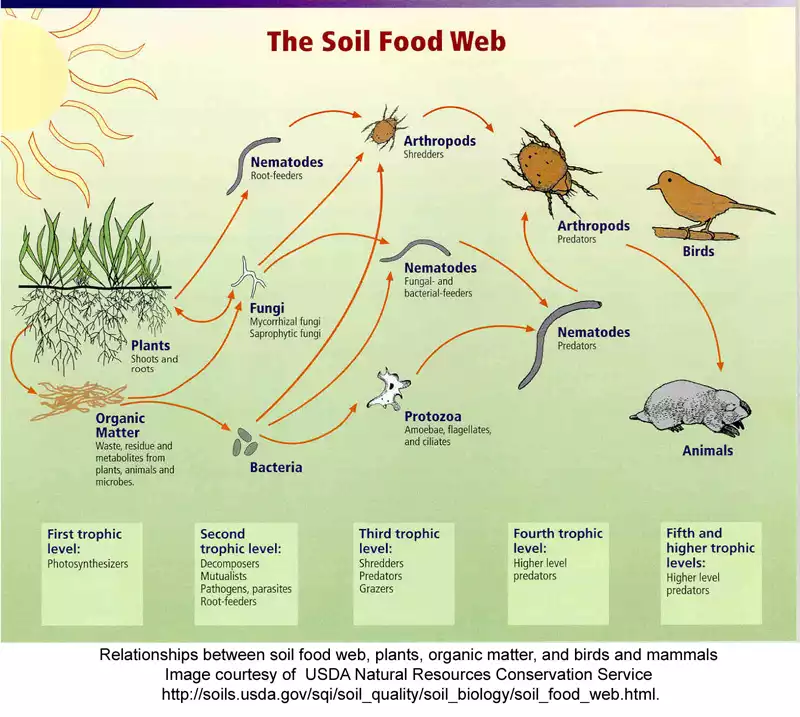
The web operates as a cycle of energy and nutrients, with each organism occupying a specific role:
Bacteria — the primary workforce
Bacteria are the most numerous organisms in living soil. A single teaspoon of healthy, biologically active soil contains between 100 million and 1 billion bacteria representing thousands of species. They decompose organic matter, cycle nutrients, and colonise the rhizosphere (the root zone) in dense communities.
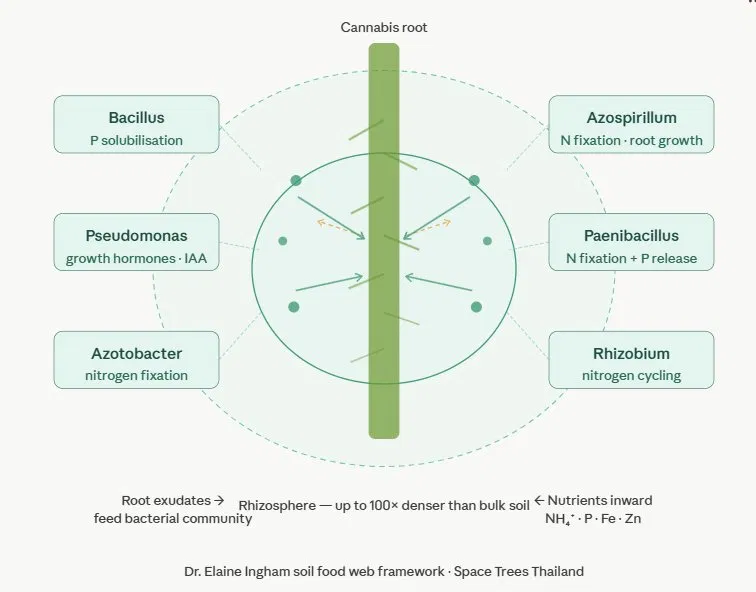
Key bacterial functions in living soil cannabis:
- Nitrogen fixation — specific bacterial species (Rhizobium, Azotobacter) capture atmospheric nitrogen and convert it into ammonium, a plant-available form
- Phosphorus solubilisation — bacteria convert insoluble phosphorus minerals into forms the plant can absorb, reducing or eliminating the need for added phosphorus
- Disease suppression — competitive bacteria occupy surface space and consume resources that would otherwise support pathogenic organisms like Pythium and Fusarium
Fungi — the long-distance transport network
Fungi extend through the soil as mycelium — networks of microscopic threads (hyphae) that can reach metres from the root zone, moving water, nutrients, and chemical signals across distances no root system could cover alone.
Mycorrhizal fungi form the most important symbiotic relationship in cannabis cultivation. The plant provides the fungi with photosynthetically produced sugars; in return, mycorrhizal networks dramatically extend the plant’s effective root surface area — by a factor of 100 or more in well-colonised soil — while delivering phosphorus, zinc, copper, and micronutrients that the root system cannot access directly.
This relationship is ancient. It predates land plants themselves. Cannabis, which evolved in diverse, biologically rich Central Asian soils, is particularly responsive to mycorrhizal colonisation, producing measurably higher essential oil content when the association is fully established.
Protozoa — the nitrogen mineralisation engine
Protozoa are single-celled organisms — amoebae, flagellates, and ciliates — that graze on soil bacteria. This grazing cycle is central to nitrogen availability in living soil.
When protozoa consume bacteria, they ingest more nitrogen than their bodies can use. The excess is excreted as ammonium — directly into the root zone, in plant-available form, in proportion to bacterial population density. Dr. Ingham describes this as a self-regulating nitrogen delivery system: the plant stimulates bacterial growth through root exudates, the protozoa population responds to the bacteria, and nitrogen is released on the plant’s biological schedule rather than the grower’s feeding schedule.
Nematodes — the multi-level regulators
Nematodes are microscopic roundworms present throughout healthy living soil. Different species occupy different trophic levels:
- Bacterial-feeding nematodes consume bacteria and release nitrogen as they excrete waste, adding another layer to the nitrogen mineralisation cycle
- Fungal-feeding nematodes regulate fungal populations and contribute to nutrient cycling
- Predatory nematodes are one of nature’s most effective biological controls against soil pests — specifically targeting fungus gnat larvae, which are among the most common root-zone threats in cannabis cultivation
Arthropods and macro-organisms
At larger scales, springtails, predatory mites, beetles, and earthworms shred organic matter into smaller particles accessible to bacteria and fungi, aerate the medium through their movement, and contribute to the physical structure of a well-functioning living soil. A healthy living soil is visibly alive — crumbly, fragrant, rich in texture, and active under any magnification.
The plant as active manager
The critical insight from Dr. Ingham’s research is that plants do not passively receive nutrition from soil — they actively direct it. Through root exudates (sugars, amino acids, and signalling compounds released continuously from root tips), plants selectively stimulate specific microbial communities in the rhizosphere. In exchange, those microbes mobilise and deliver exactly the nutrients the exudate profile signals for.
When a grower irrigates synthetic media with soluble fertiliser, they bypass this entire system. The plant is fed, but the dialogue between plant and soil biology — refined over hundreds of millions of years of co-evolution — is severed entirely.
Living Soil vs Synthetic Grows — The Real Differences
| Factor | Living Soil | Coco Coir | Hydroponics | Synthetic Soil |
| Nutrient source | Microbial activity | Bottled nutrients | Bottled nutrients | Bottled nutrients |
| Terpene complexity | Very high | Moderate | Low–moderate | Moderate |
| Pesticide use | None (IPM) | Often required | Often required | Often required |
| Ongoing input cost | Low (self-sustaining) | High | High | Medium |
| Medium re-usability | Yes — no-till | No | No | Partial |
| Residue risk in flower | Very low | Low–medium | Low–medium | Medium |
| Setup complexity | High initially | Low | Medium | Low |
| Water usage | Low | High | Very high | Medium |
| Environmental impact | Low | Medium | High | Medium–high |
| Flavonoid content | High | Moderate | Moderate | Moderate |
The performance gap narrows at the bottom of the quality spectrum and widens dramatically at the top. Mass-produced commercial cannabis grown in coco with synthetic nutrients can be consistent and potent. It rarely achieves the terpene complexity of a well-established living soil grow. The ceiling is simply lower.
How Living Soil Shapes Terpene Profiles and Effect Quality
This is the question discerning cannabis consumers most often ask: why does living soil cannabis smell and taste different?
The answer lies in secondary metabolites — the compounds a plant produces beyond those needed for basic growth. Terpenes, flavonoids, and minor cannabinoids are all secondary metabolites, and their production is directly shaped by the growing environment — including, critically, the biology of the soil.
Biological stress and terpene expression
Plants under mild, consistent biological stimulation produce more secondary metabolites as a biochemical response to their environment. In a living soil system, the constant dynamic interaction between roots and soil organisms — bacteria grazing, fungi exchanging nutrients, protozoa cycling nitrogen — creates a biochemical environment that continuously stimulates terpene and flavonoid expression.
A plant in sterile coco receiving a balanced synthetic nutrient solution has no equivalent stimulation. Its metabolic energy goes primarily into growth and reproduction, with minimal investment in the complex chemical library that makes exceptional cannabis exceptional.
Mycorrhizal colonisation in particular has been shown, across multiple plant species, to increase essential oil and secondary metabolite production measurably. Cannabis, which evolved in diverse, microbe-rich environments, is among the most responsive species to this stimulation.
Mineral complexity and terpene precursors
Many terpene and flavonoid molecules require specific mineral cofactors during synthesis. Sulphur, for example, is essential for certain terpene pathways. In living soil, sulphur-oxidising bacteria continuously convert insoluble mineral sulphur into plant-available forms. In synthetic systems, sulphur must be dosed precisely to achieve the same effect — and any imbalance registers in the terpene profile of the final flower.
Similarly, calcium, magnesium, and trace elements available through the slow release of rock dust amendments and the biological activity that unlocks them produce a mineral complexity that bottled nutrient programmes approximate but rarely match.
Flavonoids — the underappreciated component
Flavonoids — the pigments and UV protectants in cannabis that contribute to colour, aroma, and effect — are measurably higher in organically grown plant matter compared to synthetic grows, consistent with findings in organic food agriculture broadly. Cannaflavins — flavonoids unique to cannabis — have demonstrated anti-inflammatory properties in research contexts.
A living soil grow produces flower with greater flavonoid depth. Combined with a richer terpene profile, the result is what experienced consumers describe as a more complete effect — a wider entourage expression, with less of the blunt, one-dimensional quality of flower grown purely for cannabinoid content.
The No-Till Methodology — Building Soil That Improves With Every Grow
One of the most important principles in modern living soil cannabis cultivation is no-till — the practice of growing continuously in the same medium rather than disposing of it after each harvest.
Popularised in the cannabis growing community by educators including the No Till Kings, the no-till approach is grounded in an understanding of what living soil actually contains after a completed grow cycle.
A living soil bed that has hosted one completed cannabis cycle contains:
- An established mycelial network extending throughout the medium
- A diverse, stable bacterial community calibrated to cannabis root exudates
- Root channels from the previous plant improving aeration and drainage
- Decomposing root mass acting as a carbon food source for the soil community
Conventional cultivation tears all of this out. The no-till approach cuts the plant at the soil line after harvest, leaving the root system to decompose in place, top-dresses the medium with fresh organic amendments, and plants the next cycle directly into the existing living ecosystem.
Cover crops between cycles
Between cannabis cycles, cover crops — fast-growing plants including clover, mustard, buckwheat, and vetch — are sown directly into the living soil bed to:
- Maintain active root exudate production in the root zone, keeping the microbial community fed and active
- Fix atmospheric nitrogen (legumes like clover carry nitrogen-fixing bacteria on their root nodules)
- Prevent surface crusting and compaction
- Add biomass that becomes food for the soil community when incorporated before the next cannabis cycle
Companion planting during the grow
Companion plants grown alongside cannabis — basil, dill, chamomile, and marigold — add pest-deterrent volatile compounds to the canopy, attract beneficial insects, and diversify the rhizosphere microbial community through their own root exudate profiles.
This technique, standard in regenerative agriculture, contributes to the biological richness that separates a mature living soil bed from a freshly built one.
The compound effect
A no-till living soil bed in its third or fourth cycle produces noticeably better flower than one in its first. The mycelial network is denser. The microbial community is more stable and diverse. The soil structure is more developed. The relationship between plant and soil is more established.
This is the exact opposite of every synthetic growing medium, which degrades with each use. In living soil, the medium is an asset that appreciates.
Korean Natural Farming Inputs — The Soil King Approach
No discussion of modern living soil cannabis cultivation is complete without Korean Natural Farming (KNF) — a system developed by Cho Han-kyu in Korea in the 1960s, refined over decades, and brought comprehensively to the cannabis cultivation world by educators including the Soil King (BigSkyBuds / Jeremy Silva), whose practical, accessible teaching has made KNF inputs standard practice among craft cannabis growers globally.
KNF is built around producing inputs from locally sourced organic materials — fermented plant juices, indigenous microorganism collections, and naturally occurring microbial cultures — that feed soil biology, support plant health, and require minimal purchased inputs.
IMO — Indigenous Microorganism Collection
Indigenous Microorganisms are collected from the most biologically diverse local environments available — typically old-growth forest floors or bamboo groves where the soil food web is at its most established. A collection substrate (cooked grain or rice) placed in these environments is colonised by local fungi and bacteria over several days, then fermented into a concentrated microbial inoculant.
Applied to living soil or compost, IMOs introduce locally adapted microbial species that are already calibrated to the regional climate, organic matter profile, and seasonal cycles. This is a significant advantage over imported, mass-produced commercial inoculants — the microbes are native, not introduced, and require no adaptation period.
In northern Thailand, where old-growth forest floors and diverse native vegetation are accessible around Chiang Mai, locally collected IMOs carry microbial communities of exceptional diversity — including species uniquely adapted to tropical conditions that international growing guides rarely account for.
FPJ — Fermented Plant Juice
FPJ is produced by packing young, fast-growing plant material — bamboo shoots, cannabis fan leaves, sweet potato greens — tightly with brown sugar at a ratio of roughly 1:1 by weight, and fermenting at room temperature for 7–14 days. The resulting liquid contains naturally occurring plant growth hormones, amino acids, and a broad spectrum of micronutrients.
Applied as a foliar spray or root drench during vegetative growth, FPJ stimulates growth and root development through biological signal compounds rather than synthetic hormones. The plants respond to something their biology recognises.
LABS — Lactic Acid Bacteria Serum
LABS is a simple probiotic cultivated from the air around rice wash water, then multiplied in milk, producing a liquid rich in lactic acid bacteria — the same organisms found in fermented foods globally. Applied to the soil surface or as a drench, LABS competitively suppresses pathogenic bacteria and fungi (including Pythium root rot organisms) by occupying the same ecological niche and outcompeting pathogens for resources.
In Thailand’s high-humidity environment, where fungal root diseases are a persistent risk for indoor cannabis cultivation, LABS applications are a particularly valuable preventive measure.
FFJ — Fermented Fruit Juice
FFJ is produced from over-ripe or bruised fruit fermented with brown sugar, producing a concentrated liquid rich in natural sugars, potassium, and fruit hormones. Applied through the transition to flowering and continued into mid-flower, FFJ provides soil bacteria with a complex carbohydrate food source while delivering potassium for calyx development and resin production.
Together, these inputs require knowledge and preparation time. They are not compatible with a production-at-scale mentality. They are entirely compatible with craft cannabis cultivation at the quality level Space Trees Thailand is committed to.
What Goes Into Our Living Soil Mix at Space Trees Thailand
A living soil mix is not a bag of branded potting compost. It is a carefully balanced substrate designed to support biological diversity, physical structure, water management, and long-term biological fertility simultaneously.
Structural components
- High-quality compost — fully decomposed wood chips, leaf mould, and organic matter composted for a minimum of 12 months to ensure complete microbial colonisation and absence of phytotoxic compounds
- Coarse perlite or pumice (20–30% of total volume) for drainage and aeration — essential for preventing root zone anaerobic conditions in a high-organic-matter medium
- Biochar — produced by pyrolysis of organic material at high temperature, biochar provides long-term carbon storage, extraordinary water retention, and permanent micro-habitat for microbial communities. Unlike most organic inputs, biochar does not decompose and provides structural benefit to the medium indefinitely
Mineral amendments
- Rock dust (basalt or glacial rock) for slow-release trace minerals — calcium, magnesium, iron, and dozens of trace elements released over months and years as biology dissolves the mineral surface
- Oyster shell flour for calcium and pH buffering
- Kelp meal for trace elements, plant growth hormones (cytokinins), and naturally occurring chelated minerals
- Neem cake (the by-product of neem oil pressing) for phosphorus content and systemic pest deterrence — neem compounds in the root zone are taken up by the plant and expressed in the leaf surface, making the plant less palatable to certain pest species
Biological inputs
- Worm castings (vermicompost) — the most biologically dense ingredient in any living soil mix, worm castings contain enormous populations of diverse bacteria, fungal spores, and microbial metabolites that inoculate the entire medium
- Mycorrhizal inoculant applied directly to roots at transplant, before they have access to existing medium fungi
- Locally collected IMO inoculant for regional microbial diversity
- Active Aerated Compost Tea (AACT) applied at transplant and early veg — brewed by aerating a small amount of mature compost in water with a food source (molasses, kelp extract) for 24–36 hours to explosively multiply the microbial population before applying to the root zone
Integrated Pest Management Without Pesticides
One of the most significant — and most underappreciated — benefits of a properly functioning living soil ecosystem is natural pest resistance.
Biological diversity in the soil naturally suppresses pest populations through predator-prey dynamics. Predatory mites, beneficial nematodes, and a healthy population of soil arthropods keep fungus gnats, root aphids, spider mites, and other cannabis pests below damaging thresholds without any intervention from the grower. The system does the work.
When pest pressure does exceed the biological baseline, our response at Space Trees Thailand is entirely non-chemical:
- Amblyseius cucumeris (predatory mite) introduced at the first sign of thrips or broad mite activity
- Phytoseiulus persimilis for spider mite infestations
- Steinernema feltiae (entomopathogenic nematodes) applied as a soil drench for fungus gnat larval control
- Aphidoletes aphidimyza (predatory midge) larvae for aphid colonies
- Sticky monitoring cards throughout the growing environment for early detection before populations establish
This matters not just philosophically but practically and directly for the consumer. Any pesticide applied to cannabis — including approved organic options like neem oil, spinosad, or pyrethrin — leaves residues that are combusted and inhaled by the end user. In a living soil grow where biological communities manage pest pressure, the flower that reaches our shelves has never been sprayed with anything.
Seed to Sale Transparency — Why It Matters for Living Soil Cannabis
Space Trees Thailand operates as a fully licensed, seed-to-sale cannabis business in Chiang Mai, Thailand. This means we can trace every product on our shelves from the genetics we selected and the seed or clone it grew from, through the documented grow cycle, to harvest, cure, and dispensary shelf.
For living soil cannabis specifically, seed-to-sale transparency answers the questions that matter most to a quality-conscious consumer:
- Was this actually grown in living soil, or is that a marketing claim?
- Were any synthetic inputs or pesticides used?
- What genetics were grown, and how were they selected?
- Who grew this, and what is their expertise?
We grow everything in-house. We source genetics from trusted international and Thai seed breeders and nurseries, working with seed breeders and nurseries to identify elite cuts and outstanding phenotypes. We document our grow cycles. Our budtenders know the story behind every strain on our shelves because they have either grown it themselves or watched it grow from clone.
This degree of transparency is rare in the Thai cannabis market, where the supply chain for most dispensaries is entirely opaque. It is central to what Space Trees Thailand is and why our customers return.
Growing Living Soil Cannabis in Thailand — Challenges and Unique Advantages
Thailand presents conditions for indoor living soil cultivation that are specific, challenging, and in some ways remarkable — worth understanding if you want to appreciate what it takes to produce premium craft cannabis in this environment.
Climate challenges unique to northern Thailand
Northern Thailand’s climate — with relative humidity ranging from around 40% in the dry cool season to 85% or higher during the June–October monsoon — creates significant challenges for indoor cannabis cultivation. High ambient humidity demands active dehumidification to prevent botrytis (bud rot) and powdery mildew in flowering rooms. Temperature differentials between day and night in the cool season (November–February) require heating to maintain stable root zone temperatures that protect soil biology.
Living soil, with its biological diversity and active predator populations, is more resilient to these fluctuations than sterile media. The microbial community buffers against environmental extremes in ways a synthetic nutrient solution cannot — the diversity of the system is itself a form of resilience.
Advantages unique to Thailand
Exceptional local biodiversity for IMO collection. Northern Thailand’s old-growth forests, diverse native flora, and rich agricultural history produce forest floor microbiomes of extraordinary diversity. Locally collected IMOs from Chiang Mai’s surrounding forests carry microbial communities calibrated to tropical conditions — species that mass-produced commercial inoculants rarely contain and that perform exceptionally in our growing environment.
Year-round biological activity. Thailand’s tropical climate means our living soil beds never enter the biological dormancy that cold northern winters impose. The soil food web remains active continuously, allowing us to accumulate biological complexity in our no-till beds faster than growers in seasonal climates. A living soil bed that might take two years to mature in northern Europe can reach the same biological richness in 12–14 months in Chiang Mai.
Rich regional organic inputs. Thailand’s agricultural heritage provides access to exceptional organic inputs — rice bran, bamboo, diverse tropical fruit for KNF preparations, and traditional composting knowledge — that support living soil cultivation in ways that would be prohibitively expensive elsewhere.
Frequently Asked Questions
What is the difference between living soil and regular potting mix? Regular potting mix is a physical growing medium designed to anchor roots and retain moisture. It may contain some organic matter but is not managed for biological activity. Living soil is an actively managed ecosystem containing billions of microorganisms — bacteria, fungi, protozoa, and nematodes — that cycle nutrients and support plant health through biological activity. A plant in regular potting mix is fed by added nutrients; a plant in living soil is fed by the soil food web.
Does living soil cannabis produce better terpene profiles? Consistently, yes. Living soil cannabis produces richer, more complex terpene and flavonoid profiles than synthetically grown cannabis. The biological stimulation from soil organisms, the mineral complexity available through slow-release amendments, and the absence of synthetic inputs all contribute to higher secondary metabolite expression in the final flower. The difference is detectable by smell alone in premium living soil cannabis compared to commercially grown alternatives.
Is living soil cannabis safer to consume? Living soil cannabis grown with integrated pest management and no synthetic inputs carries significantly lower residue risk than commercially grown cannabis treated with pesticides. At Space Trees Thailand, our flower has never been sprayed with any pesticide or synthetic chemical input. This matters because cannabis flower is combusted or vaporised — any residue present in the flower is directly inhaled.
How long does it take to build a quality living soil? A basic living soil mix can be planted into immediately after building, but the full biological community takes 2–3 months to establish properly. No-till beds in their second, third, or fourth grow cycle produce measurably better results than first-cycle beds as the mycelial network matures, the bacterial community stabilises, and the soil structure develops. The best living soil grows come from soil with history.
What strains does Space Trees Thailand grow in living soil? We grow a rotating selection of carefully phenotype-hunted indica, sativa, and hybrid cultivars, all selected by our team from elite international and Thai genetics sources. Current and recent cultivars include Oreoz x Gushers, Fanta Sea RBX1, Gaslight, Angels Rest, Sourdough #2, and many more. Visit our dispensary at 13 Siri Mangkalajarn Road, Nimman, Chiang Mai, or check our latest menu online for current availability.
Can I visit Space Trees Thailand? Yes — we welcome visitors at both our Nimman branch (13 Siri Mangkalajarn Road, just minutes from Maya Mall) and our Old Town branch in the Thapae area. Our expert budtenders can walk you through our current living soil flower selection and answer any questions about our grow. We’re open every day from 10:00AM to Midnight.
The Bottom Line
Living soil cannabis is not a marketing term. It is a cultivation philosophy grounded in decades of soil science research — from Dr. Elaine Ingham’s foundational work on the soil food web, through the regenerative no-till methodology of the No Till Kings, to the Korean Natural Farming inputs popularised by the Soil King — applied to one of the most scrutinised crops in agriculture.
It requires knowledge, patience, and genuine commitment to a process that prioritises quality over convenience at every decision point.
At Space Trees Thailand, it is the only way we grow. Every gram of flower on our shelves was cultivated in a biologically active living soil ecosystem, without synthetic inputs, without pesticides, and with complete traceability from seed to sale. The result is cannabis that tastes the way cannabis was meant to taste — complex, expressive, and clean.
Ready to experience it for yourself?
Visit us at 13 Siri Mangkalajarn Road, Nimman, Chiang Mai — open every day from 10:00AM to Midnight — or get in touch via LINE or Facebook to check our current menu and reserve your order.