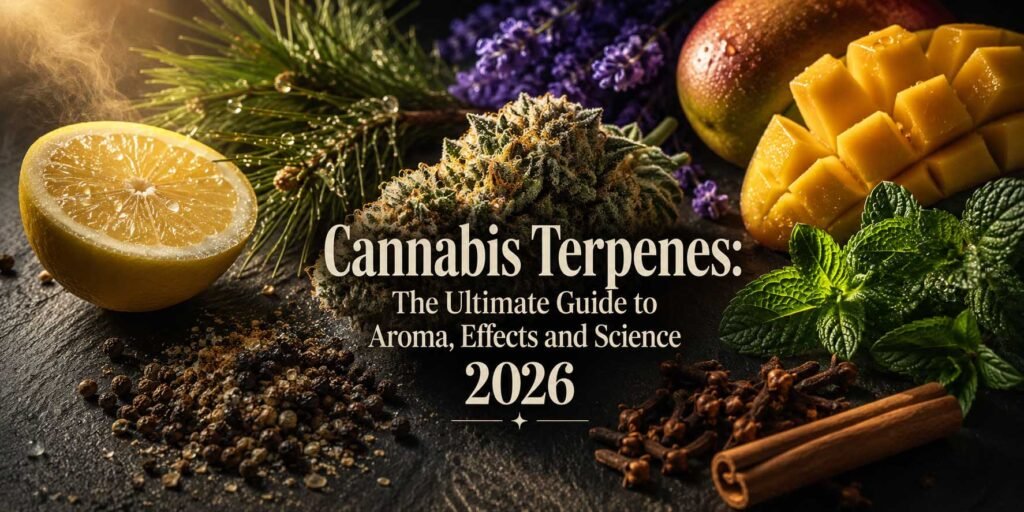
Walk into Space Trees Chiang Mai and within seconds of the first jar opening, you are experiencing cannabis terpenes at their most expressive. That wave of pine and gas from a Permanent Marker jar. The unmistakable mint-chemical hit of Mountaintop Mintz. The fruity-soapy complexity of Rainbow Marker that stops conversations mid-sentence. Every one of those aromatic experiences is produced by cannabis terpenes — the volatile organic compounds that give each strain its distinctive identity and drive much of its therapeutic effect.
Cannabis terpenes are not just about smell. They are the biochemical fingerprint of a strain, the mechanism behind the entourage effect, and increasingly the primary criterion that informed consumers use to choose what they consume. This complete 2026 guide covers everything you need to know — what cannabis terpenes are, why they matter, how the eight most important ones work, and how growing methodology determines whether the terpene potential of a plant is fully expressed or partially lost before it reaches your hands.
Table of Contents
- What Are Cannabis Terpenes?
- Why Cannabis Terpenes Matter
- The Entourage Effect
- The 8 Most Important Cannabis Terpenes
- How Cannabis Terpenes Influence Your Experience
- Terpenes Beyond Indica and Sativa
- How Living Soil Maximises Terpene Expression
- How to Preserve Cannabis Terpenes
- Terpene Testing and Reading Lab Results
- The Space Trees Terpene Series
- FAQ
What Are Cannabis Terpenes?
Cannabis terpenes are aromatic organic compounds produced in the trichomes of the cannabis plant — the same resin glands that produce THC, CBD, and other cannabinoids. Over 150 distinct terpene compounds have been identified in cannabis, each contributing to the plant’s unique aromatic and flavour profile.
Terpenes are not unique to cannabis. They are produced throughout the plant kingdom — the refreshing scent of lemons comes from limonene, the calming aroma of lavender from linalool, the sharp bite of black pepper from caryophyllene, and the distinctive smell of pine forests from pinene. These same aromatic molecules appear in cannabis, often in concentrations that make the plant one of the most aromatically complex in nature.
What makes cannabis terpenes particularly significant is their interaction with the plant’s cannabinoid system. Unlike most plants where aromatic compounds serve primarily as pest deterrents or pollinator attractants, cannabis terpenes interact directly with the human endocannabinoid system — contributing to the therapeutic and experiential effects of consumption in ways that are only now being fully understood.
Why Cannabis Terpenes Matter
For most of cannabis culture’s history, cannabis terpenes were an afterthought. THC percentage was the primary — often the only — metric consumers used to evaluate quality. A high THC number was shorthand for a good product regardless of the aromatic profile, growing methodology, or how the plant was cultivated.
That understanding has changed dramatically. Here is why cannabis terpenes are now understood to be as important as — and in many ways more nuanced than — raw cannabinoid percentages:
Therapeutic Properties Individual cannabis terpenes carry documented therapeutic properties independent of cannabinoids. Caryophyllene binds directly to CB2 receptors, providing anti-inflammatory activity without psychoactive effect. Linalool has documented anxiolytic and sedative properties. Limonene shows mood-elevating and anti-stress activity. These are not anecdotal — they are supported by a growing body of peer-reviewed research.
Strain Identity The terpene profile of a cannabis strain is its aromatic fingerprint — more specific and more informative than any other characteristic. Two strains can have identical THC percentages and completely different terpene profiles, producing entirely different consumption experiences. Understanding cannabis terpenes allows consumers to predict and select for their desired experience with far greater precision than THC percentage alone.
Flavour and Sensory Experience Cannabis terpenes are the primary driver of the flavour experience — the inhale character, mid-point complexity, exhale note, and lingering finish that distinguish an exceptional jar from an ordinary one. A terpene-rich flower in a well-grown, properly cured state delivers a sensory experience that flat, degraded, or poorly stored cannabis cannot replicate.
Quality Indicator Terpene content is one of the most reliable indicators of growing and curing quality. Cannabis terpenes are volatile — they degrade with heat, light, oxygen, and time. A jar with a loud, complex, strain-accurate terpene profile is almost always a jar of fresh, well-grown, properly cured flower. A flat or faint aroma signals degradation regardless of what the THC sticker says.
The Entourage Effect
The entourage effect is the most important concept in understanding how cannabis terpenes work. First proposed by Israeli researchers Raphael Mechoulam and Shimon Ben-Shabat in 1998, the entourage effect describes the synergistic interaction between the full spectrum of cannabis compounds — cannabinoids, terpenes, flavonoids, and other plant constituents — producing therapeutic and experiential outcomes greater than any single isolated compound can achieve.
In practical terms this means:
- Myrcene may increase the permeability of the blood-brain barrier, enhancing THC absorption and intensifying its effect
- Limonene works alongside CBD to amplify anxiolytic activity — the combined effect exceeds what either compound achieves alone
- Caryophyllene’s CB2 activity adds an anti-inflammatory dimension to the THC-dominant experience that isolated THC cannot provide
- Linalool moderates the anxiety-producing potential of high-THC strains, producing a calmer, more controlled high
This is why whole-plant cannabis consistently outperforms isolated cannabinoids in clinical settings — and why terpene-rich, full-spectrum flower grown in living soil produces a more complete, more therapeutic, and more satisfying experience than any isolated or synthetic alternative.
At Space Trees Chiang Mai, the entourage effect is not an abstract concept — it is the reason we grow in living soil, cure for a minimum of 28 days, and select genetics based on terpene profile first. Every element of our cultivation methodology is designed to preserve and maximise the full cannabis terpenes spectrum that makes the entourage effect real.
The 8 Most Important Cannabis Terpenes
Myrcene
Aroma: Earthy, musky, herbal, mango-like Also found in: Mangoes, hops, lemongrass, thyme Therapeutic properties: Sedation, muscle relaxation, anti-inflammatory, potential blood-brain barrier permeability enhancement Effect character: The most abundant cannabis terpene overall. High myrcene content is associated with the heavier, more physically sedating effect profile typically described as indica-like. Strains with myrcene above 0.5% consistently produce a more pronounced body effect. Space Trees strains: Johnny Dang, Cherry Zoap, Rainbow Marker Deep dive: [Myrcene — The Complete Guide coming soon]
Limonene
Aroma: Citrus, lemon, orange, grapefruit Also found in: Citrus fruit rinds, juniper, peppermint Therapeutic properties: Mood elevation, stress and anxiety reduction, anti-fungal, potential anti-tumour activity Effect character: Bright, uplifting, socially facilitating. Limonene-dominant strains are associated with mood enhancement and the clean, positive euphoria that makes social consumption enjoyable. The most well-documented terpene for anxiety reduction. Space Trees strains: Cherry Zoap, Rainbow Marker, Mountaintop Mintz Deep dive: [Limonene — The Complete Guide coming soon]
Caryophyllene
Aroma: Peppery, spicy, woody, clove-like Also found in: Black pepper, cloves, cinnamon, basil Therapeutic properties: Anti-inflammatory (CB2 agonist), analgesic, stress relief, potential anti-anxiety Effect character: Caryophyllene is uniquely significant among cannabis terpenes because it is the only terpene that directly binds to cannabinoid receptors — specifically CB2, the primary immune system receptor. This makes it directly relevant to inflammation, pain, and stress response in a way no other terpene can match. The dominant terpene in Permanent Marker and Johnny Dang. Space Trees strains: Permanent Marker, Johnny Dang, Cherry Zoap Deep dive: [Caryophyllene — The Complete Guide coming soon]
Linalool
Aroma: Floral, lavender, slightly spicy Also found in: Lavender, birch bark, coriander, mint Therapeutic properties: Anxiolytic, sedative, anticonvulsant, anti-inflammatory Effect character: Linalool is the calming cannabis terpene — associated with the gentle, anxiety-reducing effect that makes certain strains particularly well-suited to stress management and sleep support. It moderates THC-induced anxiety, making it a valuable component of high-potency strains that might otherwise trigger discomfort in sensitive users. Deep dive: [Linalool — The Complete Guide coming soon]
Pinene (Alpha and Beta)
Aroma: Pine, woody, fresh, resinous Also found in: Pine trees, rosemary, basil, dill Therapeutic properties: Bronchodilation, alertness, memory retention, anti-inflammatory, potential acetylcholinesterase inhibition Effect character: The alertness terpene. Alpha-pinene has the unusual property of potentially counteracting short-term memory impairment associated with THC — making pinene-dominant strains more clear-headed than their THC percentage might suggest. Also associated with the energising, forest-air clarity that certain sativa-leaning strains produce. Deep dive: [Pinene — The Complete Guide coming soon]
Terpinolene
Aroma: Fresh, herbal, floral, slightly piney, mildly citrus Also found in: Nutmeg, tea tree, cumin, apples Therapeutic properties: Mood elevation, focus, potential mild sedation at high doses, antioxidant, antifungal Effect character: The most distinctive of the less-common cannabis terpenes and the one that produces the most immediately surprising aromatic experience — the dominant terpene in Mountaintop Mintz, where it is responsible for the extraordinary mint-like freshness that defines the strain. Associated with uplifting, creative, focused effects. Space Trees strains: Mountaintop Mintz Deep dive: [Terpinolene — The Complete Guide coming soon]
Humulene
Aroma: Earthy, woody, hoppy Also found in: Hops, coriander, ginseng, sage Therapeutic properties: Anti-inflammatory, appetite suppression, antibacterial, potential anti-tumour properties Effect character: Humulene is the subtle backbone terpene — rarely dominant, but a consistent secondary note in many premium cannabis strains that adds earthy depth and contributes to the anti-inflammatory therapeutic profile. Notably associated with appetite suppression rather than stimulation, which distinguishes humulene-rich strains from high-myrcene varieties. Deep dive: [Humulene — The Complete Guide coming soon]
Ocimene
Aroma: Sweet, herbal, woody, slightly tropical Also found in: Mint, parsley, orchids, tarragon Therapeutic properties: Antiviral, antifungal, decongestant, potential anti-inflammatory Effect character: Ocimene is an uplifting, energising cannabis terpene associated with sweet, complex aromatic profiles. It appears as a secondary terpene in many fruity, tropical cultivars and contributes the soft sweet-woody note that rounds out strains like Strawberry Cough and certain Gelato phenotypes. Deep dive: [Ocimene — The Complete Guide coming soon]
How Cannabis Terpenes Influence Your Experience
The practical application of understanding cannabis terpenes is simple: they are the most reliable predictor of how a strain will make you feel, beyond the crude indica/sativa classification and far beyond THC percentage alone.
Choosing by terpene profile:
If you are seeking deep physical relaxation and sleep support — look for strains with high myrcene and linalool content. These cannabis terpenes directly support sedation and physical unwinding.
If you want mood elevation and social energy — limonene and terpinolene dominant strains are your best starting point. These aromatic compounds drive the bright, uplifting effect character associated with the best daytime cultivars.
If pain and inflammation management is your priority — caryophyllene dominant strains offer direct CB2 receptor activity. Look for strains where caryophyllene is listed as the primary or secondary terpene.
If you want creative focus without anxiety — pinene-rich strains offer the alertness and clarity that make them the most functional high-THC option for cognitive work.
If you are looking for the most distinctive sensory experience — terpinolene dominant strains like Mountaintop Mintz offer an aromatic profile unlike anything else in the cannabis world.
Terpenes Beyond Indica and Sativa
The traditional classification of cannabis into indica and sativa varieties based on their effects has been largely debunked by modern cannabis terpenes science. The botanical distinction — indica plants are shorter and bushier; sativa plants are taller and more open — describes plant morphology, not pharmacology.
The effects of a cannabis strain are determined primarily by its chemical profile — its specific combination of cannabinoids and cannabis terpenes — rather than its botanical classification. This is why:
- A high-myrcene “sativa” produces heavier, more sedating effects than the label suggests
- A limonene-dominant “indica” produces bright, mood-elevating effects that contradict the expected profile
- Two strains with identical THC percentages but different terpene compositions feel completely different
At Space Trees, we describe every strain by its terpene profile before its indica/sativa classification — because the terpenes tell the true story of the experience. Our strain blogs cover the dominant terpene composition of every cultivar on the menu in depth.
How Living Soil Maximises Terpene Expression
Not all growing methodologies produce the same cannabis terpenes profile — and the difference is not subtle.
Cannabis terpenes are synthesised through the mevalonate pathway in the plant’s trichome glands — a biosynthetic process that requires specific micronutrients, enzymatic co-factors, and biological precursors that are most effectively delivered through a living, biologically active growing medium.
In living soil — the cultivation methodology at the foundation of every Space Trees grow — a thriving microbial ecosystem of billions of bacteria per teaspoon, mycorrhizal fungal networks, and beneficial soil organisms delivers these building blocks to the root zone through natural biological pathways. The result is a plant that synthesises cannabis terpenes at the full extent of its genetic potential rather than at the level that synthetic nutrient solutions can support.
The practical difference is immediately perceptible:
- Living soil grown cannabis opens louder — the terpene presence in the jar is more immediate and more complex
- The mid-point and exhale notes are more developed — the layering of secondary and tertiary aromatic compounds that gives a great jar its depth is more fully expressed
- Terpene stability is greater — living soil cannabis holds its aromatic profile through the cure and shelf life more consistently than hydroponically grown equivalents
This is why the cannabis terpenes in a Space Trees jar smell the way they do. It is not the genetics alone — it is the living soil system those genetics are expressed through.
For a complete explanation of our living soil methodology: What Is Living Soil Cannabis? The Complete Guide
How to Preserve Cannabis Terpenes
Cannabis terpenes are volatile — they degrade with exposure to heat, light, oxygen, and time. Preserving the terpene profile from purchase to consumption requires attention to a few key principles:
Storage Store cannabis in airtight glass jars away from direct light and heat. Avoid plastic containers — certain terpene molecules interact with plastic and can leach into the container material, degrading both the aroma and the container.
Temperature Keep stored cannabis below 25°C. Heat accelerates terpene evaporation significantly. Never store cannabis near heat sources, in cars, or in direct sunlight.
Humidity Maintain relative humidity between 55–62% in storage. Too dry and terpenes evaporate; too humid and mould risk increases. Boveda or Integra humidity control packs are the easiest way to maintain optimal conditions.
Consumption Temperature When vaporising, use the lowest effective temperature — generally between 160–180°C (320–356°F). Higher temperatures destroy cannabis terpenes before they can be inhaled. Start low and increase gradually to find the temperature where your specific strain’s terpene profile is most expressive.
Handling Minimise unnecessary handling. The sticky trichomes that contain cannabis terpenes transfer easily to fingers and surfaces — every time you handle flower unnecessarily, terpenes are lost.
Grinding Grind immediately before consumption, not in advance. Pre-ground cannabis exposes far more surface area to oxygen, dramatically accelerating terpene degradation.
Terpene Testing and Reading Lab Results
As the cannabis terpenes conversation has matured, more dispensaries and producers provide detailed terpene lab results alongside cannabinoid testing. Here is how to read them:
What good terpene testing shows:
- The dominant terpene (highest percentage) — this is the primary aromatic and therapeutic driver
- Secondary terpenes — these add complexity and modify the dominant note
- Percentage concentration — premium flower typically shows total terpene content above 2%, with exceptional batches reaching 3–5%+
- Full terpene panel — not just the top 3 but the full spectrum including minor terpenes
What to look for when choosing based on terpene data:
- Dominant terpene matches your desired effect profile
- Total terpene percentage — higher is generally better for aroma and entourage effect
- Terpene diversity — a profile with 8–10 identified compounds suggests richer complexity than one with only 2–3
At Space Trees, terpene profile is a primary criterion in our pheno hunting evaluation — every strain is assessed for aromatic complexity, terpene loudness, and profile accuracy before making the menu. Read more about our selection process: Cannabis Pheno Hunting — How We Find Elite Genetics
The Space Trees Cannabis Terpenes Series
This guide is the hub of the Space Trees cannabis terpenes content series — covering the science of each major terpene in depth. As each guide is published it will be linked here:
- Cannabis Terpenes: Complete Guide — You are here
- Myrcene — The Complete Guide (coming soon)
- Limonene — The Complete Guide (coming soon)
- Caryophyllene — The Complete Guide (coming soon)
- Linalool — The Complete Guide (coming soon)
- Pinene — The Complete Guide (coming soon)
- Terpinolene — The Complete Guide (coming soon)
- Humulene — The Complete Guide (coming soon)
- Ocimene — The Complete Guide (coming soon)
For the full story behind cannabis terpenes in every strain on the Space Trees menu, browse our Strains and Products blog.
Frequently Asked Questions
What are cannabis terpenes?
Cannabis terpenes are aromatic organic compounds produced in the trichome glands of the cannabis plant. Over 150 distinct terpene compounds have been identified in cannabis, each contributing to a strain’s unique aroma, flavour, and therapeutic effect profile through interaction with the endocannabinoid system and the entourage effect.
Do cannabis terpenes get you high?
Cannabis terpenes do not produce the intoxicating high associated with THC. However they significantly influence the nature, character, and intensity of the THC experience through the entourage effect — modifying how cannabinoids interact with the brain and body. A high-myrcene strain feels different to a limonene-dominant one even at identical THC percentages.
What cannabis terpenes are best for anxiety?
Linalool and limonene are the most well-documented cannabis terpenes for anxiety reduction. Caryophyllene’s CB2 activity also provides stress-relieving properties. Strains with these terpenes as dominant compounds are the most reliable choices for anxiety management.
What is the most common cannabis terpene?
Myrcene is the most abundant cannabis terpene across all strain types. It is found as the dominant terpene in the majority of commercial cannabis strains and is primarily responsible for the earthy, musky aroma and sedating body effect associated with indica-leaning varieties.
How does living soil affect cannabis terpenes?
Living soil cultivation supports more complete terpene biosynthesis through the biological delivery of micronutrients and enzymatic co-factors through the soil’s microbial ecosystem. Cannabis grown in living soil consistently expresses more complex, louder, and more stable terpene profiles than hydroponically or synthetically grown equivalents — making living soil the cultivation methodology of choice for terpene-focused craft cannabis producers like Space Trees.
How do I choose a cannabis strain based on terpenes?
Identify your desired effect and match it to the corresponding dominant terpene — myrcene and linalool for relaxation and sleep, limonene and terpinolene for mood elevation and energy, caryophyllene for pain and inflammation, pinene for focus and clarity. Ask your budtender for the terpene lab results for any strain you are considering — at Space Trees our team can walk you through the full terpene profile of everything on the current menu.
Where can I find terpene-rich cannabis in Chiang Mai?
Space Trees Thailand on Siri Mangkalajarn Road, Nimman, Chiang Mai is Chiang Mai’s only fully licensed, seed to sale, living soil dispensary — growing every strain specifically for terpene expression and selecting genetics through our pheno hunting programme based on aromatic complexity as a primary criterion. Visit us daily 10AM–10PM.
Last updated: 2026 | Written by Sam Walker, Space Trees cultivation specialist. For educational purposes. Individual responses to cannabis terpenes vary. Always comply with Thai law regarding cannabis purchase and consumption.