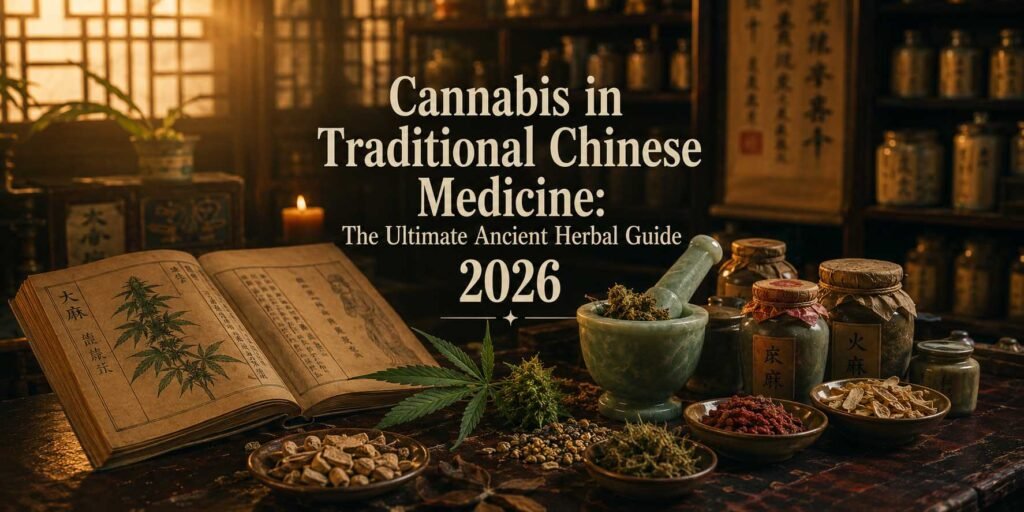
The cannabis plant has a relationship with human medicine that stretches back at least five thousand years — and nowhere is that relationship more thoroughly documented than in Traditional Chinese Medicine. Long before cannabis appeared in Western pharmacopoeia, before the 20th century prohibition era, and before the modern scientific discovery of the endocannabinoid system, Chinese physicians were systematically documenting cannabis’s therapeutic applications, cataloguing its properties, and integrating it into a sophisticated medical framework that recognised whole-plant medicine as the foundation of human wellness.
Cannabis traditional Chinese medicine — the application of má (麻), as the cannabis plant is known in Chinese — represents the world’s oldest written record of cannabis as medicine. Understanding this history is not merely academic. In a city like Chiang Mai, where Chinese-Thai culture, traditional Southeast Asian medicine, and modern cannabis science intersect, the TCM perspective on cannabis offers a profound framework for understanding the plant that is both ancient and remarkably aligned with contemporary endocannabinoid science.
Table of Contents
- Cannabis in Ancient China: The Historical Record
- Má (麻): Cannabis in the TCM Pharmacopeia
- TCM Theory and Cannabis: Qi, Meridians and Bitter-Neutral Properties
- Traditional Chinese Medicine Applications of Cannabis
- Hemp Seed: The TCM Cannabis Superfood
- The Modern Science Connection: TCM and the Endocannabinoid System
- Cannabis in Thai Traditional Medicine
- Cannabis Traditional Chinese Medicine in Chiang Mai 2026
- FAQ
Cannabis in Ancient China: The Historical Record
The written history of cannabis traditional Chinese medicine begins with one of the oldest pharmacological texts in human history — the Shennong Ben Cao Jing (神農本草經), or Shennong’s Classic of Herbal Medicine, attributed to the legendary Emperor Shennong and compiled approximately 2700 BCE, though the written version most scholars reference dates to around 100-200 CE.
In the Shennong Ben Cao Jing, má (麻) — cannabis — is listed among the 365 medicinal substances catalogued in the text, which classifies medicines into three tiers based on their properties. Cannabis appears in multiple forms:
Má Zǐ (麻子) — cannabis seed, classified as a superior medicine safe for long-term consumption Má Fén (麻蕡) — cannabis flower and leaf, classified as a middle-grade medicine with more active therapeutic properties but requiring more careful dosing
The text records cannabis as useful for treating over one hundred conditions — an early indication of the broad therapeutic scope that modern endocannabinoid science would eventually explain mechanistically.
Beyond the Shennong Ben Cao Jing, cannabis traditional Chinese medicine appears throughout the historical record:
Hua Tuo (circa 145-208 CE) — considered the father of Chinese surgery, documented using cannabis as a surgical anaesthetic under the name máfèisǎn (麻沸散, “cannabis boiling powder”), combined with wine to produce sedation sufficient for abdominal procedures. This represents one of the earliest recorded uses of cannabis as an anaesthetic in world medical history.
Li Shizhen’s Bencao Gangmu (1596 CE) — the most comprehensive TCM pharmacological text ever written, containing over 1,800 medicinal substances, systematically documents cannabis traditional Chinese medicine applications including pain relief, digestive support, and mental health — with careful notes on dosing and the distinction between therapeutic and excessive use.
This 5,000-year written record makes cannabis one of the most thoroughly documented medicinal plants in human history — and the TCM tradition one of the most valuable lenses through which to understand its potential.
Má (麻): Cannabis in the TCM Pharmacopeia
In cannabis traditional Chinese medicine, the plant is known as má (麻) — a character that also encompasses hemp and flax, reflecting the ancient Chinese understanding of the plant’s multiple valuable dimensions. Different parts of the cannabis plant carry different therapeutic classifications and applications within the TCM system:
Huǒ Má Rén (火麻仁) — Cannabis Seed The most widely used cannabis component in contemporary TCM practice. Cannabis seeds are classified as sweet in flavour, neutral in temperature, and associated with the spleen, stomach, and large intestine meridians. Primary applications include lubricating the intestines for constipation treatment, nourishing yin, and supporting recovery from illness and childbirth. Cannabis seeds contain essential fatty acids — omega-3 and omega-6 — that modern science understands as precursors to endocannabinoids.
Dà Má (大麻) — Cannabis Flower and Leaf Classified in classical texts as bitter in flavour and neutral-to-slightly-warm in temperature. Associated with the liver, spleen, and large intestine meridians. Classical applications include pain management, calming the mind, reducing inflammation, and regulating the digestive system. The active compounds in cannabis flower — cannabinoids and terpenes — are the pharmacological basis for these effects as understood through modern science.
Má Gēn (麻根) — Cannabis Root Used in classical cannabis traditional Chinese medicine for stasis conditions — helping move stagnant blood and qi — and topically for joint pain and inflammation. Modern phytochemical research has identified alkaloids and other compounds in cannabis roots with anti-inflammatory properties.
TCM Theory and Cannabis: Qi, Meridians, and Bitter-Neutral Properties
To fully appreciate cannabis traditional Chinese medicine, understanding the theoretical framework of TCM is essential. Rather than the mechanistic, reductionist model of Western medicine — identifying specific compounds acting on specific receptors — TCM describes health through the flow and balance of Qi (气), the vital life force, through a network of meridians connecting every organ and system in the body.
In TCM theory, disease arises from disrupted Qi flow — stagnation, deficiency, or excess in specific meridian pathways. Herbal medicine works by restoring balanced Qi flow through properties that are described not in molecular terms but in energetic ones: bitter/sweet/sour/pungent/salty (five flavours), hot/warm/neutral/cool/cold (five temperatures), and the meridians the herb most influences.
Cannabis traditional Chinese medicine classifies the plant as:
- Bitter and sweet in flavour — bitter herbs typically clear heat and dry dampness; sweet herbs tonify and harmonise
- Neutral in temperature — not heating or cooling the body, suitable for a broader range of constitutional types
- Spleen, stomach, large intestine, and liver meridian affinity — explaining its traditional applications in digestive regulation, liver support, and musculoskeletal pain
The philosophical alignment between TCM’s concept of Qi balance and the modern endocannabinoid system’s role in homeostasis is striking. Both frameworks understand the body as a self-regulating system that cannabis can support — one describing this in energetic terms of Qi flow, the other in molecular terms of endocannabinoid tone. The underlying model is remarkably similar.
Traditional Chinese Medicine Applications of Cannabis
The classical applications of cannabis traditional Chinese medicine map closely onto the conditions modern science identifies as most responsive to cannabis therapeutics — suggesting that centuries of empirical observation produced a remarkably accurate pharmacological understanding.
Pain and Rheumatic Conditions
The most consistently documented classical application of cannabis traditional Chinese medicine is pain relief — particularly for rheumatic conditions, joint pain, and trauma. TCM describes this as cannabis “moving stagnant Qi and blood” — language that corresponds remarkably closely to the modern understanding of caryophyllene-driven CB2 anti-inflammatory activity and THC-mediated pain pathway modulation.
Digestive Disorders
Cannabis was prescribed in cannabis traditional Chinese medicine for digestive conditions including constipation, diarrhoea, and what classical texts describe as “stomach stagnation.” Cannabis seed (Huǒ Má Rén) remains an official ingredient in the Chinese Pharmacopeia for constipation treatment — one of the few cannabis preparations still widely used in formalised TCM practice today.
Psychological and Sleep Conditions
Classical TCM texts document cannabis as “calming the shen” (心神) — shen referring to the spirit or mind in TCM theory — making it valuable for anxiety, mental restlessness, and sleep disorders. The sedating, calming properties of myrcene-dominant cannabis strains align directly with this ancient application.
Menstrual Disorders
Cannabis traditional Chinese medicine texts document its use for regulating menstruation and alleviating menstrual pain — applications now supported by cannabis’s documented anti-spasmodic and analgesic properties and its efficacy for conditions like endometriosis.
Inflammatory Conditions
Cannabis was used in TCM to address conditions TCM describes as “heat toxins” — inflammatory states — a use consistent with CBD’s and caryophyllene’s modern-understood anti-inflammatory mechanisms.
Hemp Seed: The TCM Cannabis Superfood
Hemp seed — Huǒ Má Rén (火麻仁) — deserves specific attention as the most continuously used and most officially recognised component of cannabis traditional Chinese medicine in contemporary practice.
Included in the Chinese Pharmacopeia as an official medicinal ingredient, hemp seed is prescribed in modern TCM primarily for constipation — particularly in elderly patients and those recovering from illness who present with dry, insufficient intestinal lubrication rather than gut motility disorders.
From a modern nutritional perspective, hemp seeds contain:
- Complete protein — all nine essential amino acids in ratios well-suited to human requirements
- Omega-3 and omega-6 fatty acids in an optimal ratio for endocannabinoid precursor synthesis
- Gamma-linolenic acid (GLA) — an omega-6 with documented anti-inflammatory properties
- Magnesium, zinc, iron, and B vitamins — supporting a range of physiological functions
The omega-3 content of hemp seed is particularly significant in the context of the endocannabinoid system — omega-3 fatty acids are the direct precursors to the endocannabinoids anandamide and 2-AG. A diet rich in hemp seed omega-3s supports endocannabinoid production at the most fundamental nutritional level.
The Modern Science Connection: TCM and the Endocannabinoid System
The most intellectually compelling dimension of cannabis traditional Chinese medicine is the alignment between its theoretical framework and modern endocannabinoid science.
TCM describes the body as a self-regulating system maintained in dynamic balance through Qi flow. Disruptions to this balance produce disease. Herbal medicine — including cannabis — works by restoring balance. The physician’s role is to identify the specific nature of the imbalance and select medicines that address it at a constitutional level rather than merely suppressing symptoms.
The endocannabinoid system, as understood by modern science, describes the body as a homeostatic network — maintaining physiological balance across every system simultaneously. Disruptions to endocannabinoid tone (Clinical Endocannabinoid Deficiency) produce disease across multiple domains. Cannabis works by supplementing and restoring endocannabinoid system function.
The core insight is identical. The language is different.
Both systems arrived at the same understanding — that cannabis supports the body’s own inherent self-regulating capacity — through completely different intellectual traditions separated by thousands of years. This convergence is not coincidental. It reflects what five thousand years of clinical observation in cannabis traditional Chinese medicine and three decades of modern endocannabinoid research arrived at independently: that cannabis has a uniquely broad therapeutic scope because it interacts with a uniquely broad regulatory system.
For the full science: The Endocannabinoid System: Your Body’s Hidden Regulatory Network
Cannabis in Thai Traditional Medicine
Chiang Mai sits at the intersection of Chinese and Southeast Asian herbal traditions — and cannabis traditional Chinese medicine is not the only ancient herbal framework that recognised cannabis’s therapeutic potential in this region.
Thai traditional medicine (ตำรับยาแผนไทย) — a system with deep roots in both Ayurvedic and Chinese medical traditions brought to Southeast Asia through centuries of cultural exchange — has its own relationship with cannabis. Historical Thai medicinal texts document cannabis (กัญชา, ganja) as an ingredient in traditional preparations for pain relief, muscle relaxation, appetite stimulation, and as a sleep aid.
The proximity of Chiang Mai to the Golden Triangle — historically one of the world’s most significant cannabis cultivation regions — meant that Northern Thai herbal traditions had centuries of access to and familiarity with the plant that would become controversial in the 20th century before being partially restored through Thailand’s progressive 2018 medical cannabis legislation.
Today, as Thailand moves toward a more medically formalised cannabis framework, this deep traditional herbal context gives the Thai approach to medical cannabis a cultural legitimacy that more recently cannabis-legal countries do not share.
Cannabis Traditional Chinese Medicine in Chiang Mai 2026
Chiang Mai’s position as Northern Thailand’s cultural capital — home to a significant Chinese-Thai population, a thriving traditional medicine community, and some of Thailand’s most progressive cannabis legislation — makes it a uniquely appropriate place to explore the intersection of cannabis traditional Chinese medicine and modern craft cannabis cultivation.
At Space Trees Chiang Mai, we grow cannabis in organic living soil — a cultivation philosophy that has more in common with the holistic, ecosystem-aware approach of traditional herbal farming than with the synthetic, input-heavy methods of commercial cannabis production. The same philosophical orientation that led TCM physicians to use whole plants rather than isolated compounds — understanding that the complete biological complexity of the plant produces more balanced and effective medicine than any extracted fraction — underpins our commitment to full-spectrum, terpene-rich, living soil grown cannabis.
The endocannabinoid system that cannabis traditional Chinese medicine was intuitively engaging for five thousand years is the same system our strain selection, terpene-focused cultivation, and 14/28 curing standard are designed to engage as completely as possible.
Browse the Space Trees 2026/2027 strain menu — every strain with its full terpene profile documented: Strains and Products
For the full endocannabinoid science: The Endocannabinoid System Guide For cannabis terpenes: Cannabis Terpenes: The Ultimate Guide For current Thai legal requirements: Cannabis Laws Thailand 2026
Frequently Asked Questions
What is cannabis called in Traditional Chinese Medicine?
In Traditional Chinese Medicine, cannabis is known as má (麻). Different parts of the plant have specific names — Huǒ Má Rén (火麻仁) refers to cannabis seed, Dà Má (大麻) to cannabis flower and leaf, and Má Gēn (麻根) to cannabis root. Each carries distinct therapeutic properties and applications within the TCM system.
How long has cannabis been used in Traditional Chinese Medicine?
Cannabis traditional Chinese medicine has a documented history of approximately 5,000 years. The earliest written record appears in the Shennong Ben Cao Jing, attributed to around 2700 BCE and formally compiled circa 100-200 CE. Cannabis was documented for over 100 conditions in this text and continues to appear in Chinese Pharmacopeia as an official medicinal ingredient in the form of hemp seed (Huǒ Má Rén).
What did Traditional Chinese Medicine use cannabis for?
Traditional Chinese Medicine used cannabis primarily for pain relief (particularly rheumatic and joint pain), digestive disorders (constipation and gut regulation), psychological conditions (anxiety and sleep disorders), menstrual disorders, and inflammatory conditions. These applications align closely with the conditions modern science identifies as most responsive to cannabinoid and terpene therapy.
How does TCM theory explain how cannabis works?
Traditional Chinese Medicine explains cannabis’s effects through the framework of Qi (vital energy) flow. Cannabis is classified as bitter-neutral, influencing the spleen, stomach, large intestine, and liver meridians. It works by moving stagnant Qi and blood, calming the Shen (mind-spirit), and lubricating and regulating the digestive system. This framework corresponds remarkably closely to the modern endocannabinoid system’s homeostatic function.
Is hemp seed used in Traditional Chinese Medicine today?
Yes — hemp seed (Huǒ Má Rén, 火麻仁) remains an officially listed ingredient in the contemporary Chinese Pharmacopeia, primarily prescribed for constipation management. It is one of the few cannabis preparations with continuous, uninterrupted use from ancient TCM to modern clinical practice.
How does cannabis traditional Chinese medicine relate to the endocannabinoid system?
The philosophical alignment between TCM and endocannabinoid science is striking. Both describe the body as a self-regulating homeostatic system that cannabis supports — TCM in terms of Qi balance and meridian flow, modern science in terms of endocannabinoid tone and receptor activity. The core insight — that cannabis helps the body restore and maintain its own balance — is identical. The discovery of the endocannabinoid system in the 1990s effectively provided the molecular mechanism that explains what five thousand years of TCM clinical observation had already empirically established.
Where can I access medical cannabis in Chiang Mai?
Space Trees Thailand on Siri Mangkalajarn Road, Nimman, Chiang Mai is a fully licensed, seed to sale, living soil cannabis dispensary. Our team can discuss the full terpene and cannabinoid profile of our current menu and help you choose products appropriate for your wellness needs. PT33 card and valid ID required for all purchases.
Last updated: 2026 | Written by Sam Walker, Space Trees cannabis science specialist. For educational purposes. Cannabis for medical purposes should be used under appropriate medical supervision. Always comply with current Thai law regarding cannabis purchase and consumption.