⚠️This page is actively maintained. Last verified: May 2026. Cannabis laws in Thailand are evolving rapidly. Always verify current rules through official Thai government sources before making legal or business decisions. This article is for informational purposes only and does not constitute legal advice.
Current status — quick answer Cannabis Laws in Thailand is legal for medical use only. Since June 25, 2025, cannabis flowers are classified as a “controlled herb” under Thai traditional medicine law. All purchases require a PT 33 prescription from a licensed Thai medical practitioner. Recreational sales, public consumption, and advertising are prohibited. As of April 2026, the most recent Royal Gazette update (Ministerial Regulation No. 2 B.E. 2569) has further tightened licensing requirements for dispensaries and sellers. Cannabis has not yet been returned to the narcotics list, but the government has stated its intention to do so.
Table of Contents
- What is the current legal status of cannabis in Thailand?
- The full timeline: cannabis laws from 1979 to 2026
- The 2018 milestone: Asia’s first medical cannabis legalisation
- The 2022 decriminalisation: what happened and why
- The political story behind Thailand’s cannabis revolution
- The “wild west” period: what went wrong
- The June 2025 reversal: cannabis as a controlled herb
- The latest update: April 2026 Royal Gazette regulation
- What is actually legal in Thailand today
- The PT 33 prescription system explained
- Rules for tourists: can you legally use cannabis in Thailand?
- Penalties: what happens if you break the rules
- Pros and cons: assessing Thailand’s cannabis experiment
- The future of cannabis law in Thailand
- Frequently asked questions
Cannabis Laws Thailand; What Is the Current Legal Status?
Cannabis in Thailand is legal for medical purposes only.
Since June 25, 2025, cannabis flowers — the part of the plant that contains concentrated THC — have been classified as a “controlled herb” under the Protection and Promotion of Thai Traditional Medicine Knowledge Act B.E. 2542 (1999). This classification is not a return to narcotic status; it sits under a different legal framework with different, generally less severe penalties. However, it effectively ends recreational access. Anyone wishing to purchase cannabis flower in Thailand must hold a valid PT 33 prescription issued by a licensed Thai medical practitioner.
Dispensaries operating legally must have a licensed medical professional on site during all business hours, source products from certified pharmaceutical-grade farms, and keep detailed dispensing records. The April 30, 2026 Royal Gazette publication — Ministerial Regulation on the Permission for Study, Research, or Export of Controlled Herbs, or Sale, or Processing of Controlled Herbs for Commercial Purposes (No. 2) B.E. 2569 — further tightened the licensing framework specifically for cannabis flower, distinguishing it from other controlled herbs and imposing cannabis-specific compliance conditions.
The Health Minister has publicly stated that cannabis will be returned to the narcotics list at a future point. As of May 2026, that reclassification has not yet occurred.
Space Trees Thailand operates as a fully licensed dispensary under the current legal framework with qualified practitioners on site.
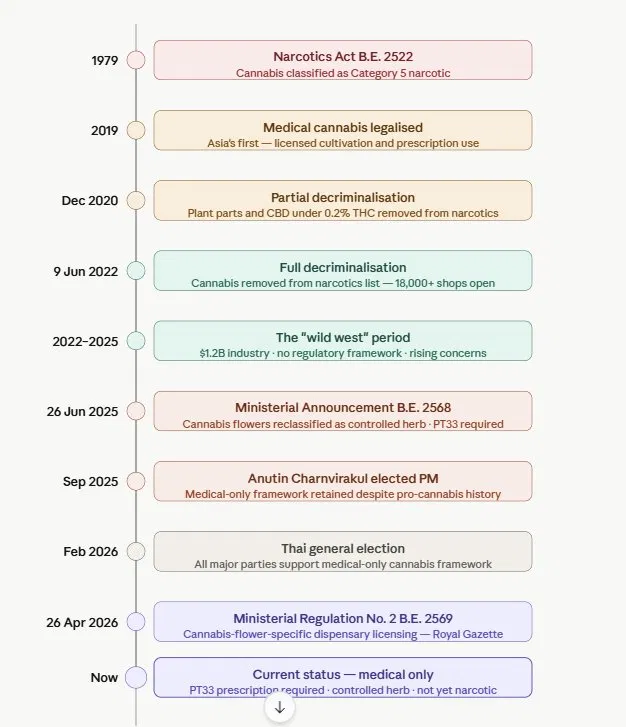
The Full Timeline: Cannabis Laws in Thailand from 1979 to 2026
Thailand’s relationship with cannabis law over the past five decades is one of the most dramatic regulatory rollercoasters of any country on earth — from one of Asia’s most punitive drug regimes, to the continent’s first decriminalisation, to a sharp reversal, all within a generation.
1979 — Narcotics Act B.E. 2522 classifies cannabis as a Category 5 narcotic. Possession, cultivation, and distribution carry severe criminal penalties including long prison sentences. Thailand becomes one of the strictest drug enforcement regimes in Asia.
Pre-2018 — Despite strict narcotics law, cannabis remains deeply embedded in traditional Thai culture, having been used in traditional medicine and cuisine for centuries. The plant appears in ancient Thai herbal texts. Enforcement targets suppliers and traffickers; individual use is widely practiced in rural areas with inconsistent enforcement.
December 2018 — Thailand announces it will become the first country in Asia to legalise medical cannabis. Amendments to the Cannabis Act 2477 BE and the Narcotics Act B.E. 2522 are announced by the government.
February 19, 2019 — Medical cannabis legalisation takes legal effect. Cultivation, distribution, and use for medical, pharmaceutical, and research purposes is permitted with a licence. The Government Pharmaceutical Organisation (GPO) begins developing cannabis-based medical products. All commercial activity requires government licensing.
2019 general election — The Bhumjaithai Party, led by Anutin Charnvirakul, campaigns explicitly on a platform of full cannabis reform, targeting economically struggling farmers in northeastern Thailand. The party runs fifth but enters the ruling coalition. Anutin is appointed Deputy Prime Minister and Minister of Public Health.
January 2022 — Thailand’s Narcotics Control Board approves the removal of cannabis and hemp from the Category 5 narcotics list, setting the stage for decriminalisation.
June 9, 2022 — Cannabis is fully removed from the narcotics list. Possession, cultivation, and consumption become legally non-punishable. On the same day, thousands of prisoners serving sentences for cannabis offences are released. The move triggers an immediate commercial boom.
Late 2022 — The Thai government distributes one million cannabis plants to Thai households to encourage home cultivation. An estimated 4,000–6,000 cannabis dispensaries open within months. Cannabis cafés, dispensaries, and street vendors proliferate nationwide.
2022–2025 — The “wild west” period. Without a comprehensive regulatory framework, the cannabis industry operates in a legal grey zone. Industry value is projected to reach $1.2 billion USD. Over 18,000 licensed dispensaries eventually register. Reported cannabis-related poisonings increase 3.5 times compared to pre-2022 baseline. Addiction-related hospital admissions increase 6.5 times. Cannabis smuggling cases emerge internationally, including seizures destined for the United Kingdom and India.
May 2023 — General election. Anutin Charnvirakul runs for Prime Minister in a now-legendary marijuana-print shirt. The Pheu Thai Party wins the majority. Anutin does not become PM; Pheu Thai takes control of the government. The promised Cannabis Act — intended to provide a comprehensive regulatory framework — stalls repeatedly in parliament.
2023–2024 — Pheu Thai PM Srettha Thavisin pledges to re-criminalise cannabis before the end of 2024. Multiple attempts at a Cannabis Act fail. A regulatory announcement reclassifying cannabis as a “controlled herb” is drafted but repeatedly delayed.
June 25, 2025 — Public Health Minister Somsak Thepsuthin signs Ministerial Announcement B.E. 2568, reclassifying cannabis flowers as a controlled herb. The announcement is published in the Royal Gazette and takes effect immediately (June 26, 2025). Recreational cannabis sales are banned. All dispensaries must have licensed practitioners on site. PT 33 prescriptions are required for all purchases. The 2022 order removing cannabis from the narcotics list is revoked.
Mid-2025 — Of 18,433 registered cannabis shops, approximately 7,297 close after failing to comply with or afford the new licensing requirements. 11,136 remain operating. The Bhumjaithai Party exits the ruling Pheu Thai coalition, partly over a leaked phone call incident involving PM Paetongtarn Shinawatra and Cambodia border tensions, partly over a cabinet seat dispute.
September 5, 2025 — Thailand’s National Assembly elects Anutin Charnvirakul as Prime Minister with 311 votes. Despite being the architect of the 2022 decriminalisation, Anutin does not reverse the medical-only framework. New elections are a condition of his coalition arrangement.
January 2026 — Additional enforcement measures take effect. All remaining dispensaries must have certified traditional medicine practitioners or qualified prescribers on site during all operating hours.
February 8, 2026 — Thailand holds a general election. All major parties, including Bhumjaithai, campaign on a medical-only cannabis platform.
April 30, 2026 — The Royal Gazette publishes Ministerial Regulation on the Permission for Study, Research, or Export of Controlled Herbs, or Sale, or Processing of Controlled Herbs for Commercial Purposes (No. 2) B.E. 2569. This regulation overlays a cannabis-flower-specific licensing layer on top of the general controlled-herbs framework, recognising that cannabis requires stricter conditions than other traditional herbs. The regulation reinforces criminal exposure for unlicensed sale, processing, or export of cannabis flower.
The 2018 Milestone: Asia’s First Medical Cannabis Legalisation
Thailand’s December 2018 decision to legalise medical cannabis was genuinely historic. It made Thailand the first country in Asia to create a legal pathway for cannabis-based medicine, ahead of any other regional government by several years.
The framework that took effect on February 19, 2019 was cautious and tightly controlled. Cultivation, processing, distribution, and prescription all required government licences. The GPO — the Government Pharmaceutical Organisation — was positioned as the primary producer and developer of cannabis-based medicines. A small number of licensed clinics could prescribe.
This period had limited commercial impact but significant cultural importance. The official acknowledgement by the Thai government that cannabis had legitimate medical value began a public opinion shift that would accelerate dramatically over the following three years. Traditional medicine practitioners who had privately used cannabis for generations suddenly had legal cover; doctors began researching applications; and Anutin Charnvirakul — who was central to the 2019 election’s cannabis reform campaign — identified the political power of the issue for rural communities.
The 2022 Decriminalization: What Happened and Why
The June 9, 2022 removal of cannabis from the narcotics list was one of the most significant and abrupt drug policy changes in Asia’s modern history. The legal change happened in a single step — cannabis was descheduled — without the accompanying regulatory framework that would normally accompany such a dramatic shift.
This was not accidental. It was deliberate political timing.
Anutin Charnvirakul had campaigned on cannabis reform to win over struggling farmers in the impoverished northeast in the 2019 elections. Three years later, his party followed through on its promise. Cannabis was removed from the narcotics blacklist, and thousands of prisoners were released that very day. Technically it wasn’t legalisation, since there were no laws to regulate the new industry — cannabis had simply been descheduled, with no regulatory system set up to replace its control.
The government distributed one million cannabis plants to Thai households, framing home cultivation as both a medical benefit and a new agricultural income source. Within months, the commercial response was staggering. By 2025, over 18,433 licensed cannabis shops had opened across Thailand — a number that reportedly exceeded the total count of 7-Eleven stores in the country.
The driving legal mechanisms of the June 2022 change were ministerial orders issued under the Narcotics Act and the authority of the Ministry of Public Health. Because they were ministerial orders rather than primary legislation, they could be reversed by the same mechanism — a vulnerability that would prove significant in 2025.
The Political Story Behind Thailand’s Cannabis Revolution
Understanding Thailand’s cannabis law requires understanding its politics — because the reclassifications of 2022 and 2025 were both as much political events as regulatory ones.
The Bhumjaithai Party built its cannabis policy around a specific electoral calculation: rural farmers in Thailand’s economically struggling northeast needed new income sources. Cannabis, as both a medicinal and agricultural crop, offered that. The 2022 decriminalisation was timed to precede the 2023 general election, maximising its political benefit to Anutin and Bhumjaithai.
When the 2023 election produced a Pheu Thai majority, the political calculus changed. Pheu Thai — a more conservative establishment party in drug policy terms — viewed the cannabis experiment’s social consequences with concern and saw political advantage in cleaning it up. Health Minister Somsak Thepsuthin, under the Pheu Thai government, became the architect of the 2025 reversal.
The 2025 political rupture — Bhumjaithai’s exit from the Pheu Thai coalition over the Cambodia incident and cabinet dispute — then produced one of Thai politics’ more ironic outcomes: Anutin Charnvirakul, the man who decriminalised cannabis in 2022, became Prime Minister in September 2025 after the 2025 reclassification had already been enacted — and declined to reverse it. The political reality had shifted. All major parties read the same polling: Thai voters, by 2025, supported a medical-only framework. The industry’s social problems had changed the public mood.
Thailand legalized medical cannabis in 2018, before becoming the first country in Asia to decriminalize adult-use cannabis in January 2022. In the three years since decriminalization, the Thai government faced public backlash over an underregulated system and concerns related to youth access and addiction rates.
The “Wild West” Period: What Went Wrong
The 2022–2025 period produced both the extraordinary commercial success and the documented social harms that drove the 2025 reversal. A fair assessment requires acknowledging both.
What the decriminalisation achieved: The economic stimulus was real and rapid. An industry projected to reach $1.2 billion in value emerged within three years. Thousands of new businesses were created. Medical access improved dramatically — patients who had previously had no affordable access to cannabis medicine could visit a dispensary and speak with a knowledgeable budtender. Tourism was stimulated, particularly among younger international visitors. Thailand’s cannabis farmers, the constituency Anutin had promised to benefit, gained genuine new economic opportunities. The prison population was immediately reduced — thousands of individuals serving narcotics sentences for cannabis were released on June 9, 2022.
What went wrong: The absence of a regulatory framework from day one created compounding problems. With no quality control standards, products far exceeding the intended 0.2% THC limit for extracted products were widely sold. With no age verification requirements enforced, youth access became a documented public health concern. Reported cannabis-related poisonings increased 3.5 times compared to the pre-2022 baseline. Addiction-related hospital admissions rose 6.5 times. Cannabis began appearing in international smuggling cases — a direct consequence of the unregulated supply chain that had developed domestically. The country’s carefully managed family-oriented tourism image faced a challenge from the proliferation of cannabis street vendors and open consumption in tourist areas.
The fundamental problem was structural: the legal change outpaced the regulatory framework. A comprehensive Cannabis Act was drafted, debated, and failed to pass parliament multiple times. The window between descheduling and framework-creation, intended to be brief, extended for over three years — long enough for an industry of 18,000+ businesses to establish itself with no clear rules.
The June 2025 Reversal: Cannabis as a Controlled Herb
On June 23, 2025, the Ministry of Public Health issued an official announcement in the Royal Gazette that reclassifies the flowering parts of the cannabis plant as a “controlled herb” under the Thai Traditional Medicine Wisdom Protection and Promotion Act. The new rules came into effect on June 24, 2025. The new announcement repeals the 2022 order that had effectively removed cannabis from the list of controlled substances and permitted widespread retail sales.
The legal document — officially titled Ministerial Announcement B.E. 2568 and informally referred to as the “Controlled Herbs (Cannabis) 2025” regulation — did the following:
It reclassified cannabis flowers specifically (not the whole plant) as a controlled herb. Stems, leaves, roots, and seeds remained in a separate legal category. The flowers — the commercially and medically significant part of the plant — became the regulated element.
It designated the legal basis as the Protection and Promotion of Thai Traditional Medicine Knowledge Act B.E. 2542 (1999) rather than the Narcotics Act. This is a critical distinction: cannabis flowers are NOT reclassified as a narcotic under the Narcotic Act. Instead, they’re regulated under the traditional medicine framework, which has different (and generally less severe) penalties than narcotics violations.
It required all commercial cannabis sales to have a licensed medical professional on site. Only certified healthcare professionals, including medical doctors, dentists, pharmacists, practitioners of traditional Thai and Chinese medicine, and registered folk healers are authorized to prescribe cannabis.
It restricted cannabis flower for 15 approved medical conditions, with a provision allowing licensed practitioners to prescribe for other conditions under their clinical judgement.
It banned recreational sales, online sales, and cannabis advertising.
Cannabis dispensaries must now convert to medical clinics to remain in business, requiring a licensed medical professional on-site who can dispense cannabis. Licensed shops may sell only limited quantities to prescription holders — a 30-day supply for personal use — and must purchase products exclusively from government-certified pharmaceutical-grade farms.
The Latest Update: April 2026 Royal Gazette Regulation
The most recent legal change is the April 30, 2026 publication in the Royal Gazette of Ministerial Regulation on the Permission for Study, Research, or Export of Controlled Herbs, or Sale, or Processing of Controlled Herbs for Commercial Purposes (No. 2) B.E. 2569 — analysed in detail by Thai legal firm Juslaws & Consult.
What the 2569 amendment does is recognise that cannabis flower is not the same as other controlled herbs. Cannabis flower carries public health, public order, and youth-protection concerns that the legacy framework was never built for. The amendment overlays a stricter, cannabis-flower-specific layer of requirements on top of the general controlled-herbs licence, while leaving the general framework intact for all other controlled herbs.
Practically, this means cannabis flower operators now face a dual compliance burden: the general controlled-herbs licensing requirements plus additional cannabis-specific conditions that the pre-existing framework did not anticipate. Criminal exposure for unlicensed sale, processing, or export of cannabis flower has not gone away; it has been reinforced by the Act’s penal provisions and by the Ministry’s enforcement push since 2025.
The strategic direction of this amendment is clear: cannabis flower in Thailand is being repositioned as a medical input flowing through a closed system of licensed, accountable, and inspected operators. The April 2026 regulation is the most recent step in building that closed system into the permanent legal framework.
What Is Actually Legal in Thailand Today
As of May 2026, the following is the clearest available summary of Thailand’s cannabis legal framework:
Legal with a valid PT 33 prescription:
- Purchasing cannabis flower from a licensed dispensary
- Possessing up to 30 grams of cannabis with valid prescription
- Consuming cannabis in private
- Domestic transport of cannabis with prescription documents
Legal without a prescription:
- Possessing and using CBD products containing less than 0.2% THC
- Growing cannabis at home (though commercial sale of home-grown product requires a licence)
- Purchasing and consuming hemp-based food and beverage products within the 0.2% THC limit
Prohibited:
- Purchasing or possessing cannabis flower without a valid PT 33 prescription
- Smoking or consuming cannabis in public places
- Selling cannabis without a valid dispensary licence and on-site practitioner
- Advertising cannabis products
- Online sales of cannabis flower
- Exporting cannabis without a specific controlled-herbs export licence
- Importing cannabis (criminal offence under the Customs Act, Narcotics Act, and Controlled Herbs Act simultaneously)
- Crossing any Thai border with cannabis
The PT 33 Prescription System Explained
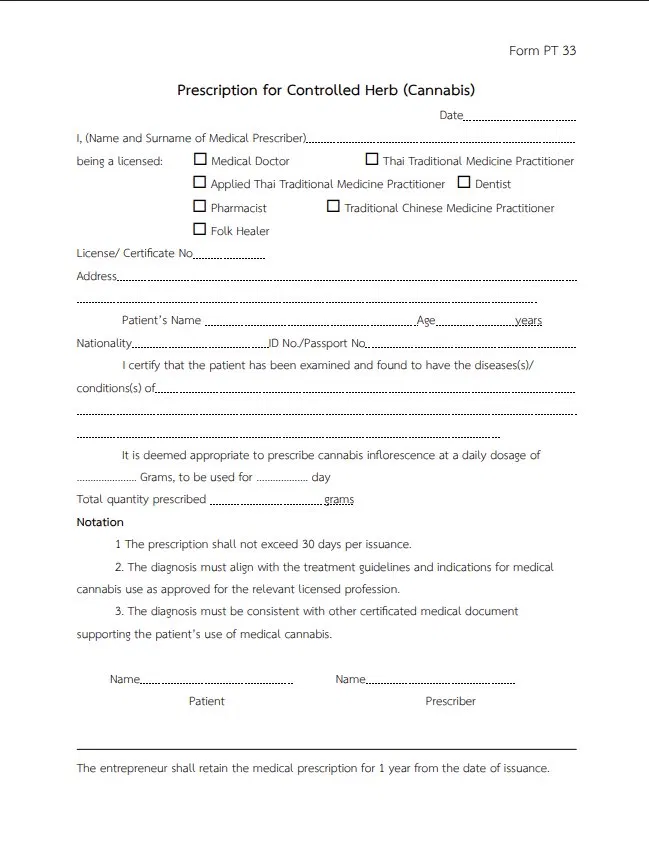
The PT 33 (Por Thor 33 / ป.ธ. 33 in Thai) is the official government prescription form required for all cannabis transactions in Thailand since June 2025. Understanding it is essential for both patients and dispensary operators.
The PT 33 is issued by a licensed Thai medical professional — this includes medical doctors, dentists, pharmacists, practitioners of traditional Thai medicine, practitioners of traditional Chinese medicine, and registered folk healers who have completed approved cannabis medicine certification. Foreign medical qualifications alone are not sufficient; the prescribing practitioner must be licensed in Thailand.
The form specifies the patient’s name, the medical condition being treated, the product type, and the permitted quantity — up to a 30-day supply for personal use. The dispensary retains a copy and the patient retains one for their own records during possession.
For tourists and short-term visitors, the PT 33 is accessible via telemedicine — Thai-licensed doctors conducting consultations remotely can issue prescriptions. Several services have emerged to facilitate this, though the regulatory status of telemedicine cannabis prescribing continues to evolve under the broader telemedicine legal framework.
The 15 conditions approved for cannabis prescription under the current framework include chronic pain, nausea and vomiting related to chemotherapy, cachexia (severe weight loss) in cancer and AIDS patients, epilepsy, multiple sclerosis, Parkinson’s disease, Alzheimer’s disease, post-traumatic stress disorder (PTSD), palliative care conditions, and others. Licensed practitioners may prescribe for conditions not on the list under their own clinical judgement.
Rules for Tourists: Can You Legally Use Cannabis in Thailand?
This is the question Thailand’s tourism industry is most often asked, and it now has a specific, clear answer: cannabis in Thailand is legal for tourists, but only with a PT 33 prescription from a Thai-licensed doctor.
Many tourists arrive in Thailand expecting cannabis to be legal based on 2022–2024 news coverage. This is no longer accurate — cannabis was recriminalised on June 25, 2025. Purchasing from dispensaries without a prescription, consuming in public, or buying from unlicensed vendors can result in fines up to 25,000 THB (~$700) and imprisonment up to 3 months.
The practical pathway for a tourist seeking legal cannabis access in Thailand in 2026:
Step 1 — Consult a Thai-licensed doctor (in person or via approved telemedicine). Describe the condition for which you want cannabis treatment.
Step 2 — If a qualifying condition is identified, the doctor issues a PT 33 prescription. Foreign medical documents may support the consultation but are not themselves valid as a prescription.
Step 3 — Present the PT 33 at a licensed dispensary with a practitioner on site.
Step 4 — Purchase a maximum 30-day supply.
Step 5 — Carry your PT 33 and receipt throughout your stay.
Step 6 — Do not travel home with any cannabis product. Taking cannabis out of Thailand constitutes a criminal offence under Thai customs law regardless of the laws of your destination country.
Public consumption — smoking cannabis in a public space — remains prohibited and carries fines of up to 25,000 THB and up to three months’ imprisonment, regardless of prescription status. Consumption is permitted in private spaces.
Penalties: What Happens If You Break the Rules
The penalty structure under the current framework reflects the controlled-herb classification rather than the historic narcotics classification — the consequences are serious but less severe than the pre-2022 regime.
For individuals (possession without prescription): Fines of up to 25,000 THB (approximately $700 USD) and/or up to 3 months’ imprisonment. The government has indicated penalties are primarily directed at sellers rather than individual consumers, though enforcement inconsistency should not be relied upon as protection.
For unlicensed sellers: Criminal charges under the Protection and Promotion of Thai Traditional Medicine Knowledge Act, which carries more significant penalties for commercial violations. The April 2026 regulation reinforced criminal exposure for unlicensed sale specifically.
For export/import violations: Multiple overlapping criminal frameworks apply simultaneously: the Customs Act B.E. 2560, the Narcotics Act B.E. 2522, and the Controlled Herbs Act B.E. 2562. Cross-border cannabis movement is treated as a serious criminal offence regardless of the controlled-herb domestic classification.
For dispensaries without proper licensing: Administrative penalties including licence suspension and fines, with criminal charges for fraud or persistent non-compliance.
If cannabis is eventually returned to the narcotics list — which the government has stated is intended — the penalty structure will increase significantly, reverting to the much heavier narcotics framework.
Pros and Cons: Assessing Thailand’s Cannabis Experiment
Thailand’s cannabis journey from 2022 to 2026 is one of the most studied natural policy experiments in modern drug law. A fair assessment acknowledges real benefits and real costs.
The case for what the 2022 decriminalisation achieved:
The economic impact was immediate and substantial. A $1.2 billion industry emerged, creating livelihoods for thousands of Thai entrepreneurs, farmers, and workers. Medical access democratised dramatically — patients who had no previous access to affordable cannabis medicine gained it overnight. Thousands of individuals imprisoned for cannabis offences were released on June 9, 2022, reducing both the human cost and the financial cost of cannabis enforcement. Thailand’s agricultural sector gained a new high-value crop. International attention highlighted Thailand as a forward-thinking medical and wellness destination.
The cultural argument also carries weight. Cannabis has been part of Thai traditional medicine and cuisine for centuries. The 2022 decriminalisation restored a cultural practice that had been criminalised under drug policy frameworks largely imposed through international pressure rather than domestic necessity.
The case against:
The documented public health data is difficult to dismiss. A 3.5-fold increase in cannabis-related poisonings and a 6.5-fold increase in addiction-related hospital admissions represent real harm. Youth access in an unregulated environment was inadequately controlled. The absence of a quality control framework meant consumers had no reliable information about product potency or purity. Cannabis smuggling cases involving Thai product reaching international destinations created diplomatic consequences. The “wild west” atmosphere — open consumption, aggressive street marketing, visible intoxication in tourist areas — damaged Thailand’s carefully constructed family tourism appeal.
The structural failure was not decriminalisation itself but the failure to accompany it with a regulatory framework. Countries with well-designed legal cannabis markets — Canada, Germany, several US states — demonstrate that the public health harms of unregulated markets can be significantly reduced through age verification, product testing requirements, quality standards, consumption regulations, and industry licensing. Thailand attempted to create an industry without the framework that makes industry safety possible.
The Future of Cannabis Law in Thailand
As of May 2026, three trajectories remain possible.
Full re-narcotisation: The government returns cannabis to the Category 5 narcotics list as stated. This would significantly increase penalties, bring cannabis fully back under the Narcotics Act, and represent a near-complete reversal of the 2022 experiment. The timeline for this step remains unannounced.
Stability at the current controlled-herb framework: The medical-only system, now reinforced by the April 2026 Royal Gazette regulation, becomes the long-term framework. The closed-system approach — licensed farms, licensed dispensaries with practitioners on site, PT 33 prescriptions — provides a workable structure for the estimated 11,000+ dispensaries operating legally. This would represent a permanently medical-only cannabis market similar to Germany’s approach.
A new Cannabis Act: A comprehensive Cannabis and Hemp Act — which has been drafted and debated since 2022 — eventually passes parliament, creating a complete regulatory framework that could accommodate medical use, research, industrial hemp, and potentially regulated recreational access with age and quality controls. With Anutin Charnvirakul as Prime Minister, some industry observers consider this the most likely long-term direction, albeit on an uncertain timeline.
Anutin Charnvirakul, a cannabis decriminalisation advocate, becomes Thailand’s Prime Minister, potentially impacting future cannabis policies. Cannabis legalisation in 2018 and decriminalisation in 2022 significantly boosted Thailand’s economy with the industry projected to reach $1.2 billion. Regulatory challenges and political changes continue to shape Thailand’s evolving cannabis industry landscape.
The direction is not determined. What is clear is that Thailand’s cannabis policy will continue to evolve, and anyone operating in or navigating the Thai cannabis market must monitor Royal Gazette publications and Ministry of Public Health announcements closely.
This page is actively maintained. We update it when new Royal Gazette publications or ministerial announcements change the legal framework.
Frequently Asked Questions
Is cannabis legal in Thailand in 2026? Cannabis is legal in Thailand for medical use only. Since June 25, 2025, all cannabis flower sales require a PT 33 prescription from a Thai-licensed medical practitioner. Recreational sales, public consumption, and advertising are prohibited. The April 2026 Royal Gazette regulation (Ministerial Regulation No. 2 B.E. 2569) further tightened the licensing framework for dispensaries. Cannabis has not been returned to the narcotics list as of May 2026, but the government has stated this is intended in the future.
Can tourists buy cannabis in Thailand? Yes, but only with a valid PT 33 prescription issued by a Thai-licensed doctor. Tourists can obtain a PT 33 through an in-person or telemedicine consultation with a licensed Thai practitioner. Foreign prescriptions are not valid in Thailand. Purchasing without a prescription, consuming in public, or buying from unlicensed sellers carries penalties of up to 25,000 THB and up to 3 months’ imprisonment.
What is the PT 33 prescription in Thailand? The PT 33 (Por Thor 33) is the official Thai government prescription form required for all cannabis purchases since June 2025. It is issued by licensed Thai medical professionals — including doctors, dentists, pharmacists, traditional Thai and Chinese medicine practitioners, and certified folk healers — and authorises the holder to purchase up to a 30-day supply from a licensed dispensary. The form specifies the patient’s name, medical condition, product type, and permitted quantity.
What happened to cannabis legalisation in Thailand? Thailand became the first Asian country to decriminalise cannabis when it removed the plant from the narcotics list on June 9, 2022. The decriminalisation was not accompanied by a comprehensive regulatory framework, leading to a rapid but unregulated industry boom of 18,000+ dispensaries. Following documented increases in cannabis-related public health incidents, youth access concerns, and international smuggling cases, the government reversed course in June 2025 — reclassifying cannabis flowers as a controlled herb and restricting sales to medical prescription holders.
Can I take cannabis out of Thailand? No. Taking cannabis out of Thailand is a criminal offence under multiple Thai laws simultaneously — the Customs Act, the Narcotics Act, and the Controlled Herbs Act. This applies regardless of the cannabis laws in your destination country. A PT 33 prescription authorises purchase and possession within Thailand only. Passengers who attempt to carry cannabis through Thai international airports or land borders face serious criminal consequences.
What does a licensed cannabis dispensary in Thailand need in 2026? Under the current legal framework, a licensed dispensary must: hold a controlled herbs licence under the Thai Traditional Medicine Act; have a certified medical practitioner — doctor, pharmacist, or qualified traditional medicine practitioner — on site during all operating hours; source products exclusively from government-certified pharmaceutical-grade farms; keep detailed dispensing records; and comply with the additional cannabis-flower-specific conditions imposed by the April 2026 Ministerial Regulation No. 2 B.E. 2569. Advertising and online sales are prohibited.
A Note on Space Trees Thailand
Space Trees Thailand is a fully licensed, seed-to-sale cannabis dispensary operating two locations in Chiang Mai — Nimman and the Old Town. We hold all required licences under the current Thai legal framework and have qualified practitioners available on site at both locations during business hours.
We are committed to operating fully within Thai law and update our practices immediately as regulations change. This article reflects our best understanding of the current legal position as of May 2026. It is not legal advice — for specific legal questions about operating a cannabis business or your rights as a patient, consult a qualified Thai legal professional.
Visit us at 13 Siri Mangkalajarn Road, Nimman, Chiang Mai — open every day 10:00AM to Midnight.
Last verified: May 2026. This page is actively maintained and updated when the Thai Ministry of Public Health or Royal Gazette publishes new cannabis-related regulations.