Last verified: May 2026. PT33 rules are current as of the June 2025 Ministerial Announcement B.E. 2568 and subsequent January 2026 dispensary compliance requirements.
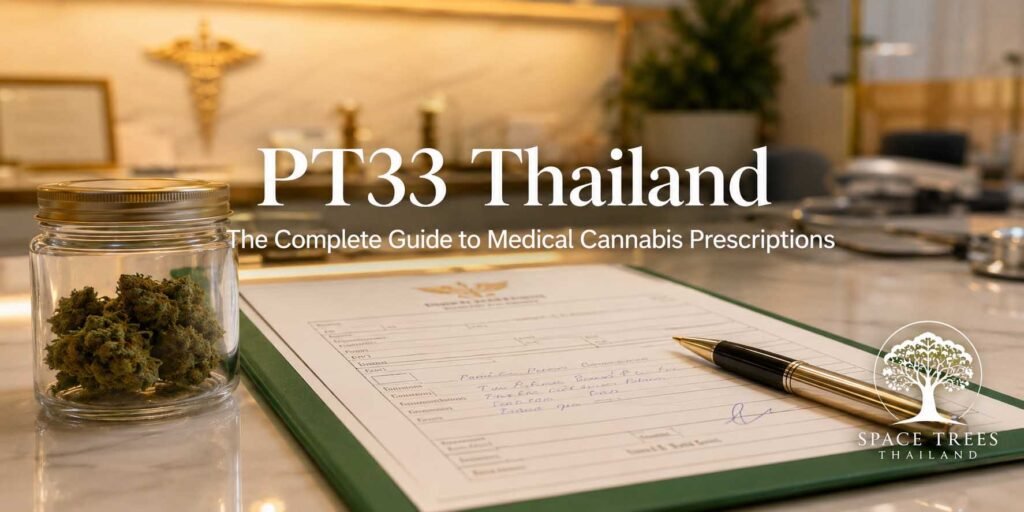
Quick answer: The PT33 (ปท. 33 / Por Thor 33) is Thailand’s official medical cannabis prescription form. It has been mandatory for all cannabis flower purchases since June 26, 2025. You get one from a Thai-licensed medical practitioner after a consultation — in person or via approved telemedicine. It is valid for 30 days and allows you to purchase up to 30 grams from any licensed dispensary in Thailand. Foreign prescriptions and medical cannabis cards from other countries are not valid.
Table of Contents
- What is the PT33?
- Why the PT33 exists — what changed in June 2025
- What information is on the PT33 form
- Who can issue a PT33 — the seven authorised prescribers
- The 15 qualifying conditions
- How to get a PT33 — step by step
- In-person vs telemedicine — your options
- Getting a PT33 in Chiang Mai
- What you can do with your PT33
- What tourists need to know
- Common misunderstandings
- Frequently asked questions
What Is the PT33?
The PT33 — officially ใบสั่งยา ปท. 33, pronounced Por Thor Sam Sip Sam in Thai — is Thailand’s official medical cannabis prescription form. The name stands for “Prescription Form Number 33” (แบบใบสั่งยา หมายเลข 33). It is issued by the Department of Thai Traditional and Alternative Medicine (DTAM) under the Ministry of Public Health, and it is the only document that legally authorises you to purchase cannabis flower and high-THC cannabis products in Thailand.
The PT33 is not filled out by the patient. It is completed, signed, and digitally registered by the prescribing practitioner during or after your consultation. Both the prescriber and the patient sign the completed form. It is registered in a central government database, which means dispensaries can verify its authenticity and authorities can check whether a prescription is genuine.
Without a valid PT33, possessing or purchasing cannabis flower in Thailand is illegal and carries penalties of up to 25,000 THB (approximately $700 USD) and up to three months’ imprisonment.
Why the PT33 Exists — What Changed in June 2025
Before June 26, 2025, cannabis in Thailand was effectively available without any prescription requirement. Following the June 2022 removal of cannabis from the narcotics list, the recreational market operated with minimal enforcement of medical requirements even though the legal framework technically required medical use.
That changed when Public Health Minister Somsak Thepsuthin signed Ministerial Announcement B.E. 2568 — the “Notification on Controlled Herbs (Cannabis) 2025” — published in the Royal Gazette on June 25, 2025 and effective from June 26, 2025. The announcement reclassified cannabis flowers as a controlled herb under traditional medicine law and required that all purchases be supported by a medical prescription.
The PT33 form was officially rolled out on July 1, 2025, establishing the standardised documentation requirement across all licensed dispensaries in Thailand. From that date, every dispensary must check and retain the PT33 before any flower transaction.
The practical effect was immediate and significant. Of the 18,433 licensed cannabis shops operating at the time, approximately 7,297 closed after failing to meet the new compliance requirements. The remaining 11,136 converted to medical-access dispensaries with practitioners on site — the model that continues today.
What Information Is on the PT33 Form?
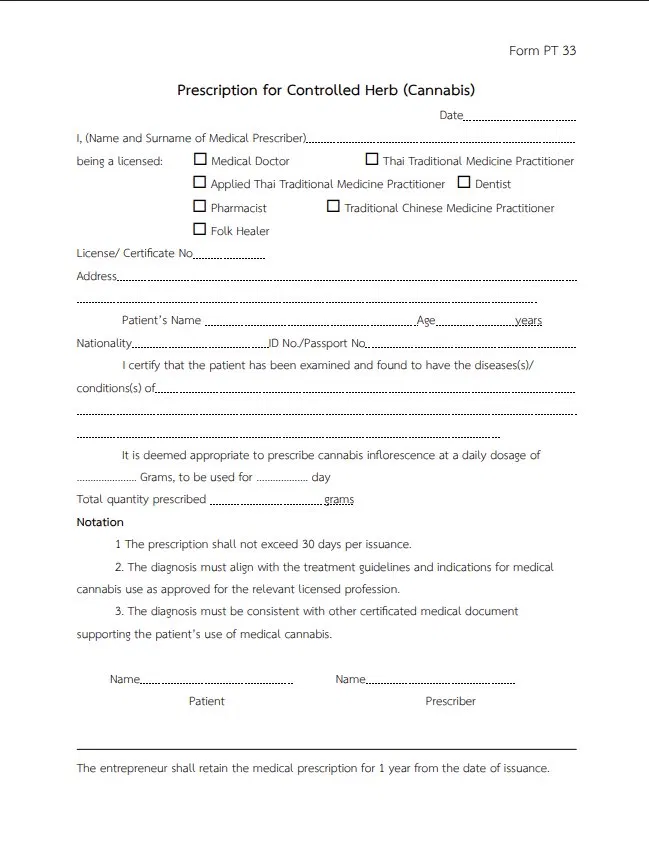
The PT33 form contains the following fields, all completed by the prescribing practitioner:
Prescriber information:
- Date of issue
- Prescriber’s full name
- Licence type (doctor, pharmacist, TTM practitioner, etc.)
- Licence registration number
- Clinic or hospital address
Patient information:
- Full name
- Age
- Nationality
- Thai National ID number or passport number (for foreigners)
Prescription details:
- Diagnosed condition or symptoms
- Daily dosage in grams
- Treatment duration in days
- Calculated total quantity in grams (cannot exceed 30 grams for a 30-day supply)
Both the prescriber and the patient sign the completed form. The prescriber simultaneously registers the prescription in the DTAM digital database (the Herbctrl portal — ระบบ Herbctrl ของกรมการแพทย์แผนไทยและการแพทย์ทางเลือก). Dispensaries check this database before completing a sale, which means a forged or expired PT33 will fail verification.
Who Can Issue a PT33? — The Seven Authorized Prescribers
Not every doctor or healthcare professional in Thailand can issue a PT33. The Ministry of Public Health has designated seven categories of practitioners as authorised prescribers — and all of them must have completed a DTAM-approved cannabis medicine training course of a minimum of 10 hours before they are eligible to prescribe.
The seven authorised prescriber categories are:
1. Medical doctors (แพทย์) registered with the Medical Council of Thailand. Standard allopathic medical doctors at private clinics, government hospitals, and cannabis-specialist clinics.
2. Traditional Thai Medicine (TTM) practitioners (แพทย์แผนไทย) registered with the Thai Traditional Medical Council. This is the most common prescriber category at cannabis dispensaries and cannabis-specialist clinics. Many licensed dispensaries employ or partner with TTM practitioners as their on-site prescribers.
3. Applied Traditional Thai Medicine practitioners (แพทย์แผนไทยประยุกต์) who hold combined traditional and modern medical training.
4. Licensed traditional medicine practitioners (ผู้ประกอบวิชาชีพการแพทย์แผนไทย) — other qualified traditional medicine professionals registered under the Traditional Thai Medicine Professions Act.
5. Dentists (ทันตแพทย์) — authorised to prescribe cannabis within the scope of dental practice (primarily for pain management).
6. Pharmacists (เภสัชกร) — authorised pharmacists at licensed dispensaries, including those who have completed the required DTAM cannabis certification.
7. Chinese Traditional Medicine practitioners (แพทย์แผนจีน) registered under Thai law.
The critical point for patients: Not all doctors and not all pharmacists can issue a PT33. The practitioner must hold the specific DTAM cannabis medicine certification on top of their general professional licence. When contacting a clinic, ask explicitly whether they have DTAM-certified practitioners who can issue PT33 prescriptions. Cannabis-specialist clinics and licensed dispensaries with on-site practitioners will always be able to confirm this.
The 15 Qualifying Conditions
The Department of Thai Traditional and Alternative Medicine (DTAM) has identified 15 primary health conditions for which practitioners may consider prescribing cannabis. The list was confirmed by DTAM’s deputy director-general Dr. Thewan Thanirat at the time the PT33 system was rolled out in June/July 2025.
The 15 conditions are:
- Chronic pain — persistent pain from any cause, including back pain, neuropathy, and post-surgical pain
- Spasms and cramps — including muscle spasms associated with neurological conditions
- Joint pain — including arthritis and rheumatic conditions
- Muscle stiffness — including conditions causing rigidity or reduced mobility
- Cancer — for symptom management and supportive care
- Nausea and vomiting — particularly treatment-related nausea in cancer patients and chemotherapy recipients
- Parkinson’s disease — for tremor management and quality of life
- Seizures — including epilepsy and seizure disorders
- Asthma — for symptom management (note: smoking is not the recommended delivery route)
- Insomnia — chronic sleep disorders
- Loss of appetite — including cachexia in cancer, HIV/AIDS, and other chronic conditions
- Anxiety — generalised anxiety disorders
- Alzheimer’s disease — for symptom management in dementia
- Depression — as an adjunct or alternative treatment under practitioner supervision
- Other conditions — at the clinical discretion of the licensed practitioner, aligned with DTAM treatment guidelines
The final point matters significantly for practical access. The list is not exhaustive. A DTAM-certified practitioner can prescribe cannabis for conditions outside the 15 if they judge it clinically appropriate and can document their reasoning. Conditions commonly cited in clinical practice that are not explicitly on the list — migraines, PTSD, chronic fatigue, multiple sclerosis — are regularly accepted under practitioner discretion.
What practitioners cannot do is prescribe without any clinical basis. The central DTAM database allows the department to monitor prescribing patterns, and practitioners who over-prescribe or prescribe without genuine clinical assessment are identifiable through the digital records system.
How to Get a PT33? — Step by Step
Step 1 — Identify a practitioner or clinic
Find a licensed cannabis clinic, hospital cannabis unit, or licensed dispensary with an on-site certified prescriber in your location. In Chiang Mai, Space Trees Thailand has a certified partner practitioner on site who can issue a PT33 on the same visit, typically within a few minutes. Alternatively, use a DTAM-approved telemedicine service (see section below) or visit any hospital TTM clinic.
Step 2 — Prepare your documentation
Bring your Thai National ID (for Thai citizens) or passport (for foreigners). Bring any existing medical records relevant to your condition — lab results, discharge summaries, previous prescriptions. These are not mandatory, but they support your consultation and can speed up the process. If you have no prior documentation, a clear, honest description of your symptoms and history is sufficient.
Step 3 — Consultation
The consultation typically takes 10–20 minutes. The practitioner will:
- Review your ID and record your details
- Discuss your condition, symptoms, duration, and any previous treatments
- Assess whether cannabis is an appropriate treatment for your condition
- Explain treatment options, dosage guidance, product types, and potential side effects
- Answer your questions about safe use
Step 4 — PT33 issuance
If the practitioner determines cannabis is medically appropriate, they complete the PT33 form specifying your diagnosis, the recommended daily dosage in grams, and the total quantity for the prescription period (maximum 30 grams for 30 days). They sign it, digitally register it in the DTAM Herbctrl database, and provide you with the physical signed form. You both sign the document.
Step 5 — Purchase at a licensed dispensary
Present your PT33 and your ID at any licensed dispensary in Thailand. The dispensary verifies the prescription against the DTAM database, confirms your identity, and records the transaction. You may purchase up to the quantity specified on your prescription.
Step 6 — Renewal
A PT33 is valid for 30 days from the date of issue. For ongoing medical use, you return to your prescriber — or any other certified practitioner — for renewal. There is no legal limit on how many times a PT33 can be renewed as long as the clinical basis is maintained.
In-Person vs Telemedicine — Your Options
Both in-person and telemedicine consultations can result in a valid PT33, but there are important practical differences between them.
In-person consultation is the most straightforward route and is fully compliant under all interpretations of the current regulations. You attend a clinic or dispensary with an on-site certified prescriber, the consultation happens face-to-face, and the PT33 is issued and signed on the spot. For visitors to Chiang Mai, an in-person consultation at Space Trees Thailand is typically completed in minutes.
Telemedicine consultation with a DTAM-authorised platform is available and widely used. Services including Cannabox MD, ThaiCannaMed, and weed.th conduct remote consultations via video call, with practitioners who are physically based at registered clinics in Thailand. The PT33 is then issued by that practitioner.
The key legal nuance with telemedicine is that the PT33 form itself must be signed by a practitioner based at a physical clinic address registered with DTAM. A fully automated online process with no licensed practitioner physically present is not compliant. Legitimate telemedicine services connect you with an actual registered practitioner for a live consultation — if the service appears to issue a prescription without any practitioner interaction, treat it with caution.
Cost: In-person consultations at specialist cannabis clinics typically cost between 200 and 800 THB depending on the clinic and the practitioner type. Telemedicine consultations through major platforms are typically in the same range. Government hospital TTM clinics may be available at lower cost or covered under the Thai Universal Coverage Scheme for Thai nationals.
Getting a PT33 in, Nimman, Chiang Mai
Chiang Mai has one of Thailand’s most developed cannabis medicine networks, with specialist clinics, licensed dispensaries with on-site practitioners, and telemedicine access throughout the city.
At Space Trees Thailand: We work with a certified partner doctor on site at our Nimman location. A PT33 consultation and issuance typically takes only a few minutes during your visit. You do not need to make a separate appointment or visit a separate clinic. This is the fastest and most convenient pathway for visitors to our dispensary.
<!– [INTERNAL LINK: Chiang Mai cannabis guide — /culture-tourism/cannabis-chiang-mai-guide/] –>
What You Can Do With Your PT33?
- Purchase cannabis flower and high-THC products from any licensed dispensary in Thailand — not only the dispensary associated with your prescriber
- Possess up to the quantity specified on the prescription (maximum 30 grams) anywhere in Thailand
- Carry your prescribed cannabis on domestic flights within Thailand — keep the PT33 and receipt with you
- Renew at any certified practitioner, not necessarily the original prescriber
A valid PT33 does not authorize you to:
- Smoke or consume cannabis in public spaces
- Purchase cannabis without presenting the form and your ID to the dispensary
- Cross any international border with cannabis — a PT33 gives no protection at Thai airports, land crossings, or sea crossings
- Purchase more than 30 grams in a single 30-day prescription period
- Share or transfer your cannabis to another person
What Tourists Need to Know
The most common mistake tourists make with the PT33 system is arriving in Thailand expecting 2022-era rules to still be in place. They do not. Since June 26, 2025, purchasing cannabis without a valid PT33 is illegal regardless of nationality.
Foreign medical cannabis cards, prescriptions, and cannabis licences from other countries are not valid in Thailand. A California medical cannabis card, a Canadian medical cannabis authorisation, or any other national medical cannabis document has no legal standing under Thai law. You need a Thai prescription.
Tourists can get a PT33. There is no citizenship requirement. Any person aged 20 or above with a qualifying condition can get a PT33 from a Thai-licensed practitioner. Passport is the required ID for foreign nationals.
The process is accessible. Same-day PT33 issuance is realistic in Chiang Mai and other major tourist areas. At Space Trees Thailand, the consultation takes minutes. There is no requirement to have visited Thailand before or to be a registered patient at a particular facility.
Keep your PT33 and purchase receipt with you. If stopped by police, you need to be able to produce both the prescription and proof of legal purchase. Possession of 30 grams without documentation is difficult to explain without it.
Do not take your cannabis home. A PT33 is valid in Thailand only. Taking cannabis through any Thai airport, land border, or port is a criminal offence. See our full guide on this separately.
Common Misunderstandings
“I just need to find any doctor.” Not any doctor can issue a PT33. The practitioner must hold DTAM cannabis medicine certification in addition to their standard professional licence. Ask explicitly before your consultation whether the practitioner is PT33-certified.
“I can get one online without seeing a doctor.” Fully automated online issuance without a live practitioner consultation is not compliant with Thai regulations. Legitimate telemedicine services connect you with a real certified practitioner via video call. The PT33 must be signed by a practitioner physically registered at a clinic address in Thailand.
“CBD products need a PT33.” No. Products containing less than 0.2% THC by weight — CBD oils, hemp tinctures, CBD cosmetics, hemp food products — do not require a PT33 and are freely available over the counter. The PT33 requirement applies only to cannabis flowers and products with more than 0.2% THC.
“My PT33 from one dispensary only works at that dispensary.” No. A PT33 is valid at any licensed dispensary in Thailand, not just the one associated with your prescriber. You are free to choose any licensed dispensary you prefer.
“I can share my prescription with a travel companion.” No. The PT33 is issued to a named individual and is non-transferable. Each person who wishes to purchase cannabis legally needs their own PT33 issued for their own condition.
Frequently Asked Questions
What is a PT33 in Thailand? The PT33 (ปท. 33 / Por Thor 33) is Thailand’s official medical cannabis prescription form. Mandatory since June 26, 2025, it is the only document that legally authorises a person to purchase cannabis flower and high-THC cannabis products from a licensed dispensary in Thailand. It is completed by a DTAM-certified licensed practitioner after a medical consultation, registered in a central government database, and valid for 30 days for up to 30 grams.
Who can get a PT33 in Thailand? Any person aged 20 or above with a qualifying medical condition can obtain a PT33 in Thailand — including tourists and short-term visitors. Thai nationality is not required. You need a passport (for foreigners) or Thai National ID, and a medical assessment by a DTAM-certified practitioner who determines cannabis is appropriate for your condition.
What conditions qualify for a PT33 prescription? DTAM has identified 15 primary qualifying conditions: chronic pain, spasms and cramps, joint pain, muscle stiffness, cancer, nausea and vomiting, Parkinson’s disease, seizures, asthma, insomnia, loss of appetite, anxiety, Alzheimer’s disease, and depression. Additionally, certified practitioners can prescribe cannabis at their clinical discretion for conditions outside this list when medically justified. Conditions frequently approved in practice include migraines, PTSD, and multiple sclerosis.
How long is a PT33 valid and how much cannabis can I buy? A PT33 is valid for 30 days from the date of issue and authorises the purchase of a maximum of 30 grams during that period. The specific quantity is written on the form by the prescriber and may be less than 30 grams depending on the recommended dosage and treatment duration.
Can I get a PT33 the same day I arrive in Chiang Mai? Yes. At Space Trees Thailand, our certified partner practitioner can issue a PT33 during your visit, typically within a few minutes. Same-day issuance is also available via DTAM-approved telemedicine services (Cannabox MD, ThaiCannaMed, weed.th) and at specialist cannabis clinics throughout Chiang Mai.
Does my PT33 work at all dispensaries in Thailand? Yes. A PT33 issued by any DTAM-certified practitioner is valid at any licensed dispensary across Thailand. You are not required to purchase from the dispensary associated with your prescriber.
Getting Your PT33 at Space Trees Thailand
Space Trees Thailand has a certified partner practitioner available on site at our Nimman location during business hours. A PT33 consultation and issuance typically takes only a few minutes — there is no separate clinic visit, no advance appointment required, and no additional registration process.
Visit us at 13 Siri Mangkalajarn Road, Nimman, Chiang Mai — open every day 10:00AM to Midnight.
Get Directions Order via Line Official
Continue in the Legal and Regulation series:
- Read More about Cannabis Laws in Thailand.
- [Thailand cannabis law timeline — every change from 1934 →] [INTERNAL LINK: /legal-regulation/thailand-cannabis-law-timeline/]
- [Can tourists buy cannabis in Thailand? The 2026 guide →] [INTERNAL LINK: /legal-regulation/can-tourists-buy-cannabis-thailand/]
- [Taking cannabis out of Thailand →] [INTERNAL LINK: /legal-regulation/taking-cannabis-out-of-thailand/]
Last verified: May 2026. PT33 rules are based on Ministerial Announcement B.E. 2568 (June 2025) and DTAM guidance current as of this date. This article does not constitute legal or medical advice. For personal medical decisions, consult a licensed Thai medical practitioner.