The cannabis supply chain is the invisible journey your flower takes before it ever reaches your jar — and in Thailand’s fast-grown market, that journey is exactly where quality quietly disappears. Most cannabis sold at dispensaries, whether grown locally or imported, passes through multiple hands, multiple handling stages, and an unknown amount of time on the way to you. This guide explains how the cannabis supply chain actually works, why it degrades your flower, how to spot the difference, and why a short, farm-controlled chain is the single biggest quality decision a dispensary can make.
Key takeaways:
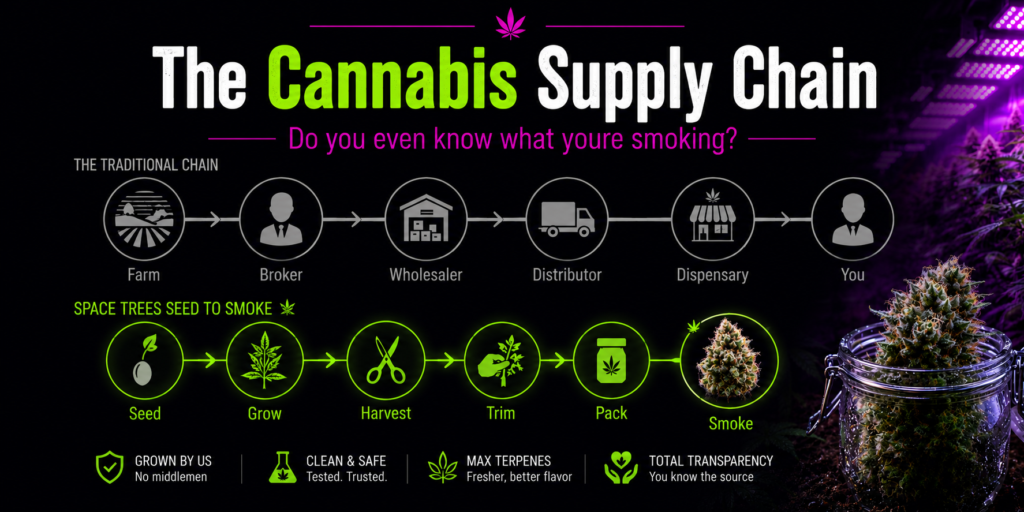
- A typical cannabis supply chain runs farm → broker → wholesaler → dispensary → you, and no one in that chain reliably knows the harvest date, storage history, or handling count.
- Imported overstock cannabis arrives already aged, compressed in transit, and frequently relabelled with strain names disconnected from the genetics inside.
- Terpenes are volatile and THC degrades into sedating CBN over time, so old flower smells flat, smokes harsh, and feels foggy rather than clean.
- At Space Trees Thailand the supply chain is just four touches — Grow, Harvest, Trim, Pack & Serve — because we are the farm.
Table of Contents
- The Question Nobody Asks at the Dispensary Counter
- What Is the Cannabis Supply Chain?
- The Local Wholesale Problem
- The Import Problem: How Cannabis Travels to Thailand
- Why Old Cannabis Loses Its Quality
- Fresh vs Degraded Cannabis: How to Tell
- The Space Trees Answer: A Four-Touch Supply Chain
- Frequently Asked Questions
The Question Nobody Asks at the Dispensary Counter
When you walk into a cannabis dispensary and pick up a jar, you probably look at the strain name, the THC percentage, and the look of the flower through the glass. You might ask about the terpene profile or the effects. You almost certainly do not ask the questions that matter most: how old is this, who grew it, how many people handled it, and how was it transported?
Most dispensaries could not answer accurately even if you asked, because they do not know. The cannabis arrived from a supplier, who got it from a wholesaler, who sourced it from a farm or a broker. Somewhere in that chain the provenance became vague, incomplete, or was never recorded at all. That gap is the cannabis supply chain problem — and it is more common in Thailand’s current market than most consumers, even experienced ones, realise.
What Is the Cannabis Supply Chain?
The cannabis supply chain is every step a flower passes through between the plant and your purchase. In a typical Thai-market jar, that chain looks like this: a commercial farm harvests at scale, sells to a broker, who sells to a wholesaler, who distributes to a dispensary, who sells to you. Each arrow in that sequence adds time, handling, cost, and uncertainty.
The length of the chain is the problem. Cannabis is not a durable commodity — it is a fragile agricultural product whose value lives in volatile compounds that fade with every day and every touch. A long supply chain trades exactly those qualities away. Understanding the chain is the first step to buying better, and it starts with how flower is distributed locally.
The Local Wholesale Problem
Thailand’s cannabis market expanded rapidly after 2022. Thousands of dispensaries opened, and demand outstripped the capacity of properly established grow operations to supply it. The result was a market dominated by large-volume farms distributing through networks of brokers, wholesalers, and redistributors. This mirrors how most agricultural commodity markets behave under fast commercial pressure — but it creates specific quality problems for cannabis that do not apply to other crops.
The freshness problem. A farm harvesting hundreds of kilograms cannot sell it all immediately. Product sits in storage — sometimes properly, often not — while distribution is arranged. By the time it passes through a wholesaler and a secondary distributor to a dispensary, weeks or months have passed. The date on the packaging, if any, may be the packaging date, not the harvest date.
The handling problem. Each link involves physical handling: unloading, inspecting, repackaging, transporting, storing, sorting. Each event costs trichomes — the fragile resin glands that carry THC, terpenes, and cannabinoid complexity. They break under friction. Flower handled six times has lost measurably more than flower handled twice.
The strain integrity problem. When cannabis moves through multiple layers, the rigorous strain documentation a grower keeps rarely travels with it. Labels are applied at the point of retail packaging — which may not be the farm. The strain name on a wholesale jar reflects what whoever packed it decided to call it, not necessarily the genetics inside.
The markup problem. Every link adds margin: farm to broker, broker to wholesaler, wholesaler to dispensary, dispensary to you. You pay the accumulated cost of every transaction — and what has been traded away at each step, in favour of margin, is time, care, and process.
The Import Problem: How Cannabis Travels to Thailand
Beyond the domestic chain, Thailand’s market has a second source of low-quality, poorly traceable product: imported cannabis from oversupplied markets. North American legal markets produced significant commercial overstock in recent years, making large volumes available cheaply to anyone willing to transport them — and some of it found its way to Thailand. Every stage of that journey costs quality.
| Stage | What happens | Quality cost |
|---|---|---|
| 1. Overstock at origin | Produced for a market that didn’t absorb it; held in storage for weeks or months | Already not fresh before it sells |
| 2. Export prep | Compressed, vacuum-sealed and concealed for transport, not preserved | Crushed trichomes; humidity uncontrolled |
| 3. International transit | Days to weeks by air or sea with temperature and humidity swings | Further terpene and structural degradation |
| 4. Import & relabelling | Passes through more handlers; exotic or Thai strain names applied | Genetics label becomes purely nominal |
| 5. Dispensary shelf | Arrives weeks, months, or over a year post-harvest | No provenance trail — only the label |
This is what some consumers in Chiang Mai are buying without knowing it, because there is no provenance trail to read — only the label on the jar.
Why Old Cannabis Loses Its Quality
Two chemical realities explain why a long cannabis supply chain ruins flower. First, terpenes are volatile: the aromatic compounds that give cannabis its smell, flavour, and much of its character evaporate and oxidise with time, heat, light, and handling. Second, THC degrades into CBN — as THC ages and is exposed to heat and light, it converts into cannabinol, a cannabinoid with primarily sedative properties. Old cannabis therefore carries more CBN relative to THC than fresh flower of the same genetics, which is why it feels drowsy and foggy regardless of the THC number on the label. That number was measured at a point in time that may be long past.
If you want the science of how aroma compounds shape an experience, our complete guide to cannabis terpenes breaks it down. The takeaway here is simple: freshness is not a luxury, it is the chemistry of a good session.
Fresh vs Degraded Cannabis: How to Tell
Experienced consumers have all bought something that looked right and smoked wrong. The difference between fresh, well-cured flower and old, poorly handled flower shows up across every sense — here is what to notice:
| Marker | Fresh, well-cured flower | Old / degraded flower |
|---|---|---|
| Nose | Opens and develops; intensifies when broken or ground | Flat and muted; doesn’t evolve when broken |
| Smoke | Genuinely smooth | Harsh, with a chemical or oxidised edge |
| Flavour | Lingers and changes across the session | Short, muted finish that vanishes fast |
| Effect | Clean and specific to the cultivar | Heavy, foggy, sedating (the CBN signature) |
| Head | Clear | Headache-adjacent heaviness behind the eyes |
None of this is how cannabis is supposed to feel. If it is familiar, it is because the flower was not what it should have been by the time it reached you. Fresh, single-origin flower behaves the opposite way: the nose layers, the smoke is smooth, the flavour lingers and shifts, and the effect is specific to the genetics — the difference between a high-myrcene evening cultivar and a high-limonene daytime one is real, not nominal.
The Space Trees Answer: A Four-Touch Supply Chain
We do not have a supply chain in the usual sense — we are the farm. Every gram at Space Trees Thailand was grown in our own living soil grow rooms in Chiang Mai, harvested by us, dried for 14 days, cured for 28 days in our own jars, trimmed by our team, and served by our budtenders. Four touches — Grow, Harvest, Trim, Pack & Serve — and nothing else.
| Typical cannabis supply chain | Space Trees | |
|---|---|---|
| Touches | 6+ (farm, broker, wholesaler, distributor, dispensary, you) | 4 (Grow, Harvest, Trim, Pack & Serve) |
| Harvest date known? | Rarely | Always logged |
| Genetics verified? | Nominal label only | Selected and grown in-house |
| Cure control | None | The 14:28 Protocol, enforced |
That short chain is why the 14:28 Protocol — 14 days of drying, 28 days of curing — is even possible: there is no wholesaler, broker, or distributor to skip it. We know exactly how old every batch is because we logged the harvest, exactly what genetics are in each jar because we grew them, and exactly how the flower was handled because we handled it. As a fully licensed, seed-to-sale operation under Thailand’s Food and Drug Administration, we control every variable from genetics selection to the moment your budtender opens the jar.
What you buy at Space Trees is not the product of a supply chain. It is the product of a process — and the chain that kills cannabis stops at our door. Explore what that produces in our strain library.
Frequently Asked Questions
What is the cannabis supply chain? It is every step cannabis passes through between the plant and your purchase — typically farm, broker, wholesaler, dispensary, then you. The longer the chain, the more time and handling degrade the flower before it reaches you.
Why does old cannabis feel different even with high THC? Because THC degrades into CBN, a sedating cannabinoid, as flower ages and is exposed to heat and light. Old cannabis feels foggy and drowsy regardless of the THC percentage on the label, which was measured at an earlier point in time.
How can I tell if cannabis is fresh? Fresh flower has an aroma that opens and intensifies when broken, smokes smoothly, has a flavour that lingers and evolves, and gives a clean, cultivar-specific effect. Flat smell, harsh smoke, and a heavy foggy high point to old or poorly handled product.
Is imported cannabis lower quality? Often, yes. Imported overstock has usually aged before export, is compressed and stressed in transit, and is frequently relabelled — so the genetics named on the jar may have no connection to what’s inside.
How is Space Trees cannabis different? We are the farm, so our supply chain is just four touches. We log every harvest date, grow our own verified genetics, and enforce the 14:28 Protocol for drying and curing — none of which is possible when a flower passes through brokers and wholesalers.
Connect With Space Trees
Visit Space Trees Thailand — 13 Siri Mangkalajarn Road, Nimman, Chiang Mai Open every day 10:00AM to Midnight.