Understanding THC vs CBD is the single most useful thing a new patient can learn, because these two compounds shape almost everything about how a cannabis product will make you feel. THC is the intoxicating compound behind the classic “high”; CBD is non-intoxicating and is chosen for calm, balance, and symptom relief without a buzz. Knowing the difference — and, more importantly, how they work together — helps you choose the right product, the right dose, and the right time of day. This guide breaks down THC vs CBD in plain language for patients, and shows how it fits Thailand’s medical-cannabis framework at Space Trees in Chiang Mai. For the bigger picture, it links up to our complete medical cannabis patient guide throughout.
Table of Contents
- THC vs CBD at a Glance
- What Is THC?
- What Is CBD?
- THC vs CBD: The Key Differences
- How THC and CBD Work Together
- Understanding CBD:THC Ratios
- THC vs CBD Under Thai Law
- Which Is Right for You?
- THC vs CBD at Space Trees Chiang Mai
- Frequently Asked Questions
THC vs CBD at a Glance
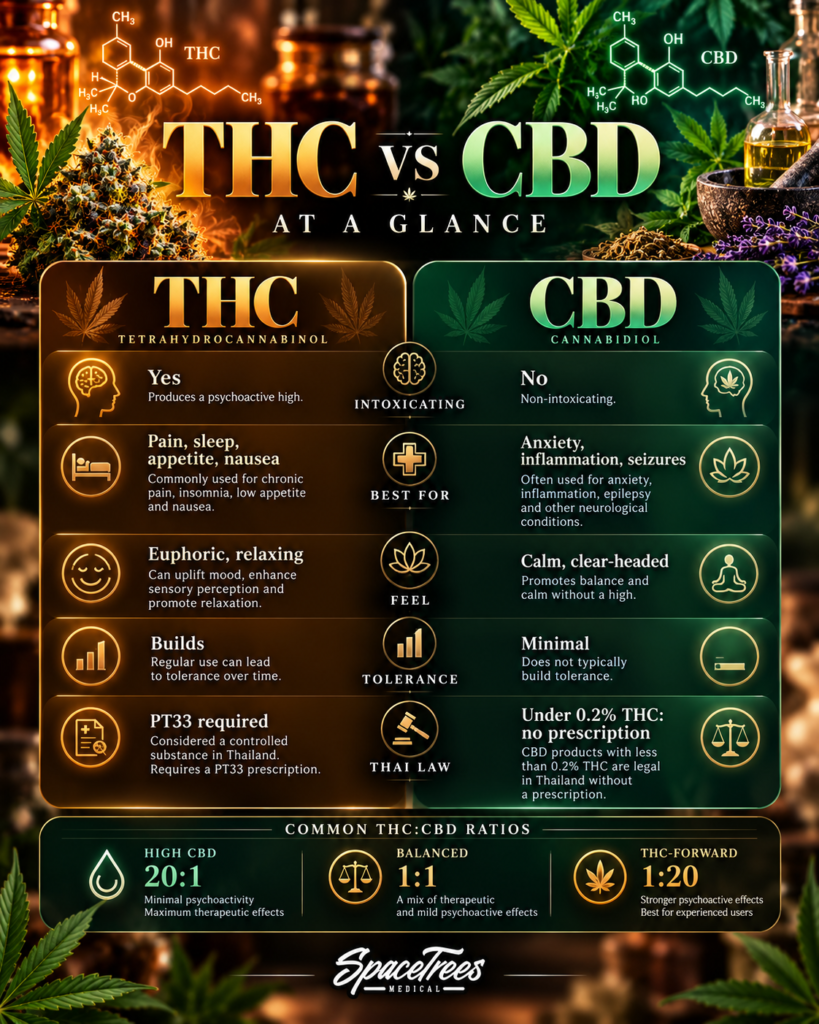
Here is the short version of THC vs CBD before we go deeper:
| THC | CBD | |
|---|---|---|
| Full name | Tetrahydrocannabinol | Cannabidiol |
| Intoxicating? | Yes — causes the “high” | No |
| Best known for | Pain, sleep, appetite, nausea | Anxiety, inflammation, seizures |
| Typical feel | Euphoric, relaxing, sedating at higher doses | Calm, clear-headed, grounding |
| Tolerance over time | Builds with regular use | Minimal |
| Thai prescription | PT33 required | Products under 0.2% THC: no prescription |
| Best starting point | Low dose, evening use | Daytime symptom relief |
What Is THC?
THC (tetrahydrocannabinol) is the main intoxicating compound in cannabis — the one responsible for the euphoric, mind-altering “high.” It works by binding directly to CB1 receptors in the brain and nervous system, which is what changes mood, perception, and the sense of time, and triggers the release of feel-good neurotransmitters.
Beyond the high, THC does real therapeutic work. It is strongly associated with relief from chronic pain, poor sleep, low appetite, and nausea, which is why THC-forward flower and oils are common choices for those symptoms. The trade-off is that THC can cause temporary side effects such as dry mouth, a racing heart, or anxiety if the dose is too high — the reason every patient should start low and go slow.
What Is CBD?
CBD (cannabidiol) is the main non-intoxicating compound in cannabis. It will not get you high, because unlike THC it barely binds to the brain’s CB1 receptors. Instead, CBD influences the body more indirectly, nudging the endocannabinoid system and other receptors toward balance.
Patients reach for CBD for calm without intoxication: it is widely used for anxiety and stress, inflammation, and as a daily, clear-headed option you can take and still go about your day. It also has the best-established evidence of any cannabinoid for certain rare seizure disorders. Because it does not build tolerance the way THC can, CBD suits long-term, everyday use. To go deeper on its uses, see our guide to the benefits of CBD.
THC vs CBD: The Key Differences
The core of THC vs CBD comes down to one word: intoxication. THC alters how you feel and think; CBD does not. From that single difference, most of the others follow.
THC tends to be the stronger tool for physical symptoms with an acute edge — significant pain, sleeplessness, appetite loss, and nausea — but it asks for more care with dosing and time of day. CBD is the gentler, steadier tool, better suited to anxiety, inflammation, and maintaining an even baseline through the day. THC can build tolerance with frequent use; CBD generally does not. And crucially, the two are not rivals — most patients do best not with “maximum THC” but with the right balance of the two for their condition.
How THC and CBD Work Together
THC and CBD are more effective together than either is alone — a phenomenon called the entourage effect, in which cannabinoids and aromatic terpenes interact to shape and soften the overall experience. CBD, in particular, can take the edge off THC: it tends to temper the anxious, racing-heart feeling that too much THC can bring, making a balanced product feel smoother and more manageable.
This is why a 1:1 THC:CBD oil often feels gentler and more functional than a pure-THC product at the same dose. Understanding why this happens means understanding the body’s own signalling network — our explainer on the endocannabinoid system breaks it down in plain language.
Understanding CBD:THC Ratios
In practice, the THC vs CBD question becomes a ratio question. Products are often labelled with a CBD:THC ratio, and that ratio is your best guide to how a product will feel:
| Ratio (CBD:THC) | Feels like | Often chosen for |
|---|---|---|
| High CBD (e.g. 20:1) | Clear-headed, minimal-to-no high | Anxiety, inflammation, daytime use |
| Balanced (1:1) | Gentle, functional, mild lift | Pain with manageable head effects |
| THC-forward (e.g. 1:20) | Noticeably intoxicating | Strong pain, sleep, appetite, nausea |
There is no universally “best” ratio — only the one that matches your symptom, your tolerance, and your day. Many patients start higher in CBD and add THC gradually until they find the sweet spot.
THC vs CBD Under Thai Law
Thailand’s rules treat THC and CBD differently, and the dividing line is 0.2% THC. Cannabis and hemp extracts containing more than 0.2% THC by weight are controlled, and any THC-containing cannabis flower is medical-only — every legal purchase requires a valid PT33 (Por Thor 33) prescription from a licensed practitioner. CBD products that fall under 0.2% THC do not require a prescription and are sold more freely, though they remain regulated as foods, cosmetics, or supplements depending on the product. These limits are overseen by Thailand’s Food and Drug Administration under the Ministry of Public Health.
In short: if a product has meaningful THC, you will need a PT33 in Thailand. For the full legal picture, see our complete guide to cannabis laws in Thailand, and for how the prescription works, our medical cannabis patient guide.
Which Is Right for You?
Start from your symptom and your day. If you need to stay clear-headed and functional — managing daytime anxiety, stress, or inflammation — lean toward CBD or a high-CBD ratio. If your main issue is significant pain, poor sleep, low appetite, or nausea, a balanced or THC-forward product is more likely to help, ideally used in the evening when a little intoxication is fine.
Whatever you choose, begin with a low dose, give each product time to show its full effect, and keep a simple note of what works. The goal of THC vs CBD is not to chase potency — it is to find the smallest effective dose and the right balance for you. Our on-site practitioner and budtenders are there to help you dial that in.
THC vs CBD at Space Trees Chiang Mai
Space Trees is a fully licensed, seed-to-sale medical cannabis dispensary in the heart of Nimman, Chiang Mai. We grow our own flower in living soil and stock a range of THC-forward, balanced, and CBD-rich options, so we can match the THC vs CBD balance to your needs rather than pushing the strongest thing on the shelf. Our on-site certified practitioner can issue your PT33 and walk you through dosing.
Whether you are managing a long-term condition or simply want to relax without feeling overwhelmed, we will help you start safely and confidently. To see how we grow our medicine, read our living soil cannabis guide, and when you are ready, visit Space Trees in Nimman to talk to our team.
This article is for educational purposes only and is not medical advice. Cannabis in Thailand is available to qualifying patients with a valid PT33 prescription from a licensed practitioner. Please consult a qualified practitioner and consume responsibly in accordance with Thai law.
Frequently Asked Questions
What is the main difference between THC and CBD?
THC is intoxicating and causes the cannabis “high”; CBD is non-intoxicating and does not. THC is best known for pain, sleep, appetite, and nausea, while CBD is chosen for anxiety, inflammation, and clear-headed daily relief.
Is CBD or THC better for pain?
Both can help, and research suggests a combination is often most effective. THC tends to be stronger for acute or severe pain, while CBD adds anti-inflammatory support and can make a THC product feel smoother. Many patients use a balanced 1:1 ratio.
Will CBD get you high?
No. CBD is non-intoxicating and will not produce a high on its own. It can even soften the intoxicating, anxious edge of THC when the two are taken together.
Do I need a prescription for THC or CBD in Thailand?
Any cannabis product with meaningful THC is medical-only and requires a valid PT33 prescription. CBD products under 0.2% THC do not require a prescription but are still regulated.
What CBD:THC ratio should a beginner start with?
Beginners often start with a higher-CBD ratio (such as 20:1 or 1:1) and add THC gradually. Start with a low dose, wait to feel the full effect, and adjust slowly with guidance from a practitioner.
Can you take THC and CBD together?
Yes — and many patients prefer to. Taken together they produce an “entourage effect,” with CBD tempering some of THC’s stronger effects for a gentler, more functional experience.
Connect With Space Trees
Come see us in Nimman, Chiang Mai, or reach out online — our team is happy to help you choose the right flower for your needs under Thailand’s PT33 medical framework.