11-Hydroxy-THC is the real reason a cannabis edible can feel so much stronger, slower, and longer-lasting than smoking or vaping the exact same plant. It is not a mystery of “bad batches” or unreliable dosing — it is basic liver chemistry. When you eat cannabis, your body converts THC into a different, more potent compound before it ever reaches your brain, and understanding that conversion is the single best way to dose edibles safely. This guide explains the science in plain language and frames it within Thailand’s medical-only PT33 system. It is educational information, not medical advice.
Table of Contents
- 11-Hydroxy-THC at a Glance
- What Is 11-Hydroxy-THC?
- First-Pass Metabolism: Why Eating Cannabis Is Different
- Why 11-Hydroxy-THC Feels So Much Stronger
- Why Edibles Take So Long to Kick In
- Smoking vs Eating: The Same Plant, Two Different Highs
- Dosing Edibles With 11-Hydroxy-THC in Mind
- Edibles Under Thailand’s Medical Framework
- Frequently Asked Questions
11-Hydroxy-THC at a Glance
| Question | Short answer |
|---|---|
| What is it? | A metabolite the liver creates when it breaks down THC from edibles |
| How is it made? | First-pass metabolism in the liver, mainly via the CYP2C9 enzyme |
| Is it stronger than THC? | Yes — it crosses the blood-brain barrier more readily and binds CB1 more tightly |
| Why the delay? | Digestion + liver processing takes time before it reaches the bloodstream |
| Typical onset | 30 minutes to 2 hours, depending on the product and your metabolism |
| Typical duration | Often 4–8 hours, longer than smoking or vaping |
This is why “start low, go slow” is not just cautious advice — it reflects real, measurable pharmacology.
What Is 11-Hydroxy-THC?
11-Hydroxy-THC (11-OH-THC) is a metabolite — a compound your body creates while processing another compound. In this case, it is what the liver produces when it breaks down Delta-9-THC, the primary intoxicating cannabinoid in cannabis. You do produce small amounts of 11-hydroxy-THC when you smoke or vape too, but the quantity is minor compared to what happens after you eat cannabis, where it becomes the dominant psychoactive compound circulating in your bloodstream.
This distinction matters because most people assume “THC is THC” regardless of how it enters the body. It isn’t. The route of consumption fundamentally changes which compound your brain actually experiences, and that is the whole story behind why edibles feel like a different experience than smoking, even at a similar labelled dose.
First-Pass Metabolism: Why Eating Cannabis Is Different
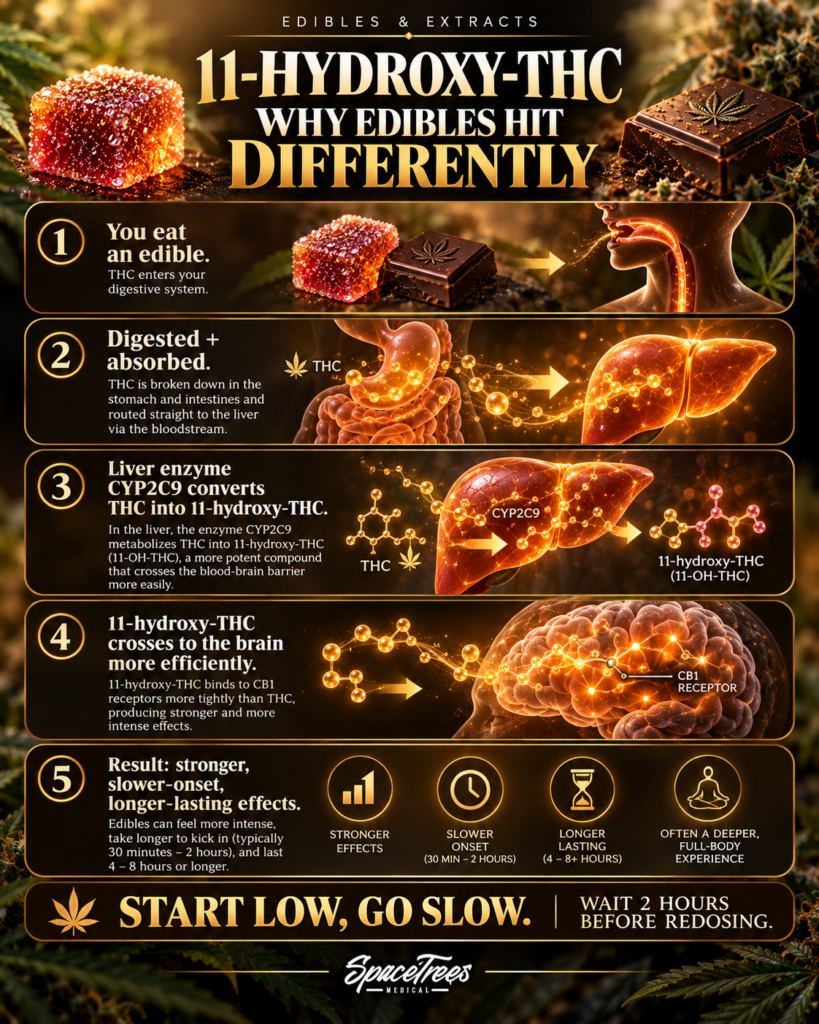
When you smoke or vape cannabis, THC enters your bloodstream almost directly through the lungs, bypassing the liver on its first pass through the body. When you eat cannabis, the path is completely different: THC travels through your digestive system, gets absorbed into the bloodstream, and is carried straight to the liver before it reaches anywhere else — a process called first-pass metabolism.
In the liver, an enzyme called CYP2C9 converts a significant portion of that THC into 11-hydroxy-THC before it is released back into general circulation. By the time the compound reaches your brain, you are no longer dealing with the same molecule you swallowed — you are dealing with its more potent liver-made cousin. This single biochemical step is the reason edibles and inhaled cannabis can produce such different experiences from what looks like the same starting dose.
Why 11-Hydroxy-THC Feels So Much Stronger
Potency comes down to two properties: how easily a compound reaches the brain, and how tightly it binds once it gets there. 11-hydroxy-THC outperforms regular THC on both counts. It crosses the blood-brain barrier more efficiently, and it has a higher binding affinity for the CB1 receptor — the same receptor responsible for cannabis’s intoxicating effects. The tighter and more efficient that binding, the stronger and more sustained the activation of the receptor.
Controlled research backs this up directly: when volunteers were given equal, small intravenous doses of THC and 11-hydroxy-THC, the 11-hydroxy-THC produced a faster onset and a noticeably more intense psychoactive effect. Human metabolism studies published on the U.S. National Library of Medicine (PMC) confirm 11-hydroxy-THC as a major active metabolite of THC formed through this pathway. In practical terms, a modest amount of THC eaten in a gummy or chocolate can generate a disproportionately strong experience once it is converted — which is exactly why edible doses are measured in single-digit milligrams while inhaled sessions are often measured far more loosely.
Why Edibles Take So Long to Kick In
The same first-pass process that makes edibles stronger is also what makes them slow. Before any conversion can happen, the cannabis has to be digested, absorbed through the gut, and processed by the liver — a sequence that typically takes 30 minutes to 2 hours, depending on your metabolism, what else is in your stomach, and the specific product’s formulation. Fat content in a meal can speed absorption of fat-soluble THC, while an empty stomach may lead to faster but less predictable onset.
This delay is the single most common cause of edible overconsumption: people who do not feel anything after 30–45 minutes often take more, not realising the first dose simply has not finished converting yet. Two doses stacked on top of each other, both converting into potent 11-hydroxy-THC around the same time, is how a manageable dose turns into an uncomfortable one. For a deeper breakdown of onset timing across product types, see our guide on how long edibles take to kick in.
Smoking vs Eating: The Same Plant, Two Different Highs
Because inhaled cannabis bypasses the liver on its first pass, smoking or vaping delivers mostly unmetabolised THC directly to the brain — fast onset (often under 10 minutes), but also a faster decline, typically within 1–3 hours. Edibles are the opposite: slow to arrive, but once the liver has converted a meaningful share of the dose into 11-hydroxy-THC, the effects tend to be stronger and last considerably longer, often 4–8 hours or more.
Neither route is “better” — they are genuinely different experiences from the same plant, and matching the route to your goals matters. Someone wanting a short, controllable session might prefer flower; someone wanting sustained relief through the evening, or overnight, might prefer a carefully dosed edible. Our team at Space Trees can talk through which route fits what you are looking for.
Dosing Edibles With 11-Hydroxy-THC in Mind
The practical takeaway from all of this chemistry is simple: respect the delay, and dose conservatively. Start with a low milligram amount, especially if you are new to edibles or trying a new product. Wait at least 2 full hours before considering more — not 30 minutes — because that window covers the realistic range of when first-pass metabolism finishes doing its work. Avoid mixing edibles with alcohol, which can intensify and unpredictably extend the effects.
Keep in mind that body weight, metabolism, what you have eaten that day, and even genetic variation in CYP2C9 activity all influence how much 11-hydroxy-THC you personally generate from the same dose — which is why two people can eat an identical gummy and report very different experiences.
Edibles Under Thailand’s Medical Framework
In Thailand, edibles and extracts sit within the same PT33 medical-only framework as cannabis flower. A licensed practitioner sets your authorised daily dosage as part of your prescription, and understanding 11-hydroxy-THC’s delayed, amplified effect is exactly the kind of information that consultation should cover — particularly for anyone new to oral cannabis products. Buying only from licensed dispensaries also means the milligram dosing on the label is accurate, which matters enormously given how much the conversion to 11-hydroxy-THC can amplify an underdosed product.
Frequently Asked Questions
What is 11-hydroxy-THC?
It is a metabolite the liver produces when it breaks down THC from edibles, via an enzyme called CYP2C9. It is more potent than regular THC because it crosses the blood-brain barrier more readily and binds more tightly to CB1 receptors.
Why do edibles feel stronger than smoking the same amount of THC?
Because eating cannabis routes THC through the liver first (first-pass metabolism), converting much of it into 11-hydroxy-THC — a compound that reaches the brain more efficiently and binds more tightly than regular THC, producing a stronger effect from what can be a smaller labelled dose.
How long does it take for 11-hydroxy-THC to kick in?
Typically 30 minutes to 2 hours, since the compound only forms after digestion and liver processing. This is slower and less predictable than inhaled cannabis, which reaches the brain in minutes.
Why do edibles last longer than smoking?
11-hydroxy-THC is cleared from the body more slowly and binds more persistently to CB1 receptors, which is why edible effects commonly last 4–8 hours compared to 1–3 hours for inhaled cannabis.
Is it safe to take more of an edible if I don’t feel anything after 30 minutes?
Not recommended. The most common cause of edible overconsumption is taking a second dose before the first has finished converting. Wait at least 2 hours before considering more.
Are edibles legal in Thailand?
Yes, within the same PT33 medical framework as cannabis flower. A licensed practitioner sets your authorised dosage, and purchases must come from a licensed dispensary.