Knowing how to spot a licensed cannabis shop in Chiang Mai is now the single most important step for any patient or visitor, because Thailand’s rules have shifted firmly toward medical-only supply. Since 2025, thousands of outlets have closed or failed to renew, and the government has launched an official online map so anyone can confirm whether a shop is legal. This guide explains what a licence actually means today, how to use the Department of Thai Traditional and Alternative Medicine (DTAM) map, what to look for in-store, and the red flags that should make you walk away. For the wider picture, start with our Cannabis Tourism in Thailand pillar guide. This is educational information, not legal advice.
Table of Contents
- Licensed Cannabis Shop in Chiang Mai: Quick Checklist
- Why Does Shop Licensing Matter in 2026?
- What Does a Cannabis Licence Mean Today?
- How Do You Use the DTAM MC-GIS Map?
- What Should You See Inside a Licensed Shop?
- What Are the Red Flags of an Unlicensed Shop?
- What Is Changing Under the New Cannabis Bill?
- Why Choose a Licensed Cannabis Shop in Chiang Mai?
- How Do You Report an Illegal Shop?
- Frequently Asked Questions
Licensed Cannabis Shop in Chiang Mai: Quick Checklist
The fastest way to judge any licensed cannabis shop in Chiang Mai is to run through four checks before you buy anything. The table below compares what a legitimate, licensed outlet looks like against the warning signs of an unlicensed one.
| Check | Licensed cannabis shop (what you should see) | Unlicensed shop (red flag) |
|---|---|---|
| Official map listing | Shop name and address appear on the DTAM MC-GIS map | Not on the map, or name/address does not match |
| Prescription step | Consultation with an authorised practitioner before any flower sale | Sells flower over the counter with no offer of PT33. |
| Age check | Refuses anyone under 20 | No age or ID questions |
| Records | Keeps your prescription on file and logs each sale | No paperwork at all |
| Product source | Can tell you where the flower was grown (GACP-certified farms) | Vague or no answer on origin |
| Sales channels | In-store sales only | Vending machines |
| Marketing | Quiet, information-led signage | Promotions, discounts and party-style advertising |
If a shop fails even one of the first two checks, treat that as a reason not to buy.
Why Does Shop Licensing Matter in 2026?
Licensing matters because the legal ground under cannabis retail in Thailand has moved. A shop that was legal to open in 2022 is not automatically legal to operate today, and the responsibility for checking increasingly sits with the buyer as well as the seller.
After cannabis was removed from the narcotics list in 2022, shops opened rapidly across the country. The Ministry of Public Health then reversed course. A notification that took effect on 26 June 2025 requires a prescription from an authorised practitioner before flower can be sold. Thai media reported that around 7,000 outlets closed or did not renew during 2025, and that roughly 11,000 remained legally registered by April 2026.
For visitors, this means the number of shops you see on the street is not the number that are operating within the rules. Choosing a licensed cannabis shop in Chiang Mai protects you from unsafe or untested product, and it keeps you on the right side of a framework that is still tightening. Our Cannabis Laws in Thailand guide covers the full legal history.
What Does a Cannabis Licence Mean Today?
A cannabis licence today means the shop is registered with DTAM to sell controlled herbal cannabis for medical purposes, under strict conditions. It is not a general retail permit, and it does not allow recreational sales.
Under the current rules, licensed sellers must check a valid prescription for every flower sale, keep that prescription on file, record each transaction, and supply only flower from farms certified under Good Agricultural and Collection Practices (GACP). Reports indicate a prescription generally covers up to 30 days’ supply. Shops also need qualified staff, and a Ministerial Regulation that came into force on 30 April 2026 raised the bar for licence renewal, so stand-alone outlets without a medical or pharmaceutical connection may not qualify when their licence term ends.
In practice, that is why the medical consultation step matters so much. In Thailand the prescription is commonly referred to as a PT33, and you can read exactly how that works in our PT33 prescription guide. A legitimate, licensed cannabis shop in Chiang Mai will walk you through it rather than skip it.
How Do You Use the DTAM MC-GIS Map?
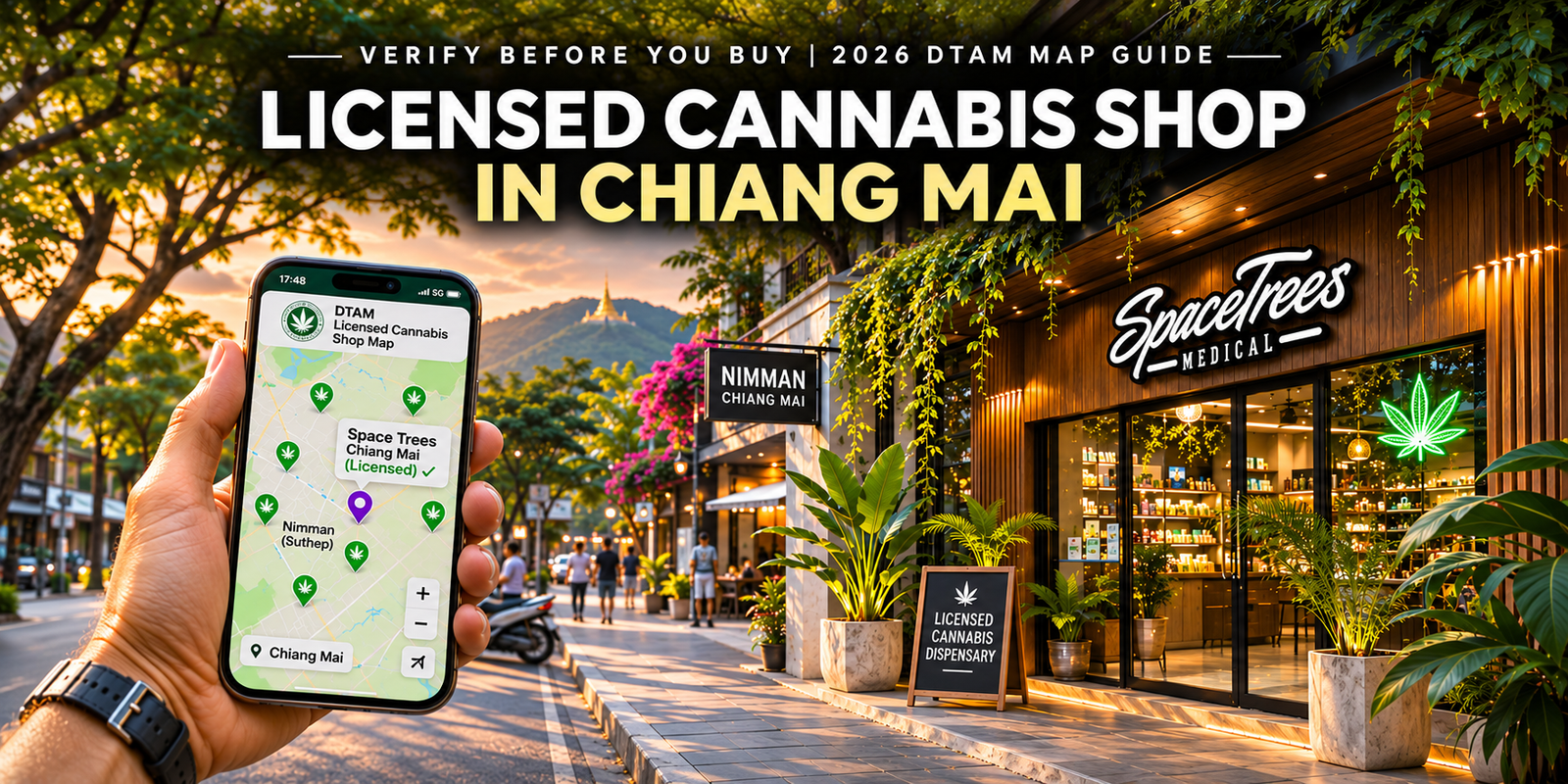
The DTAM Medical Cannabis GIS (MC-GIS) map is the official way to check a shop. It was launched in April 2026 and shows licensed cannabis outlets and cultivation sites, so you can confirm a shop’s status before you walk in.
Step 1: Open the official source
Go to the Department of Thai Traditional and Alternative Medicine website at dtam.moph.go.th and follow the link to the cannabis shop map. Using the department’s own site is safer than trusting a link from a flyer, chat message or third-party page.
Step 2: Search by area
Zoom to Chiang Mai, then to the neighbourhood you are in, such as Nimman, Old Town or the Night Bazaar area. You can also search by district and scroll to the street.
Step 3: Match name and address exactly
Compare the listing with the shop sign and street address. Small differences matter. A similar-sounding name at a different address is not the same licence.
Step 4: Decide before you buy
If you cannot find the shop, do not buy there. A missing listing does not always mean fraud, as maps can lag, but the safe default is to choose a shop you can verify. You can look up any licensed cannabis shop in Chiang Mai, including ours in Nimman, in exactly the same way.
What Should You See Inside a Licensed Shop?
Inside a licensed shop you should see a calm, clinic-like process, not a sales pitch. Staff should ask about your health needs, refer you to an authorised practitioner for a consultation, and only then discuss suitable products.
Expect to be asked your age, since sales to anyone under 20 are not allowed, and expect staff to decline sales to people who are pregnant or breastfeeding. Good shops explain where their flower was grown, how it was stored, and can often show lab results. If you want to know what those reports mean, our guide on how to read a cannabis COA walks through each section.
Some provincial health offices have reportedly issued colour-coded stickers to licensed premises. Treat a sticker as a helpful sign, not proof, because stickers can be copied. The map remains the main check, and the conversation at the counter is the second.
What Are the Red Flags of an Unlicensed Shop?
The clearest red flag is a shop that will sell you flower without any consultation or prescription. That is not how a licensed cannabis shop in Chiang Mai is allowed to operate in 2026.
Other warning signs include offers of delivery to your hotel, ordering through LINE or Telegram, vending machines, loud discounts or “happy hour” promotions, staff who cannot say where the product came from, and no questions about age. Online sales and delivery of flower are widely reported as not permitted, and advertising cannabis is restricted. If any of these show up, the safest choice is to leave and find a verified shop.
Buying from an unlicensed seller carries real risks: untested product, unknown pesticide or mould levels, and the possibility of being caught up in enforcement action. It also undermines the medical framework that legitimate operators are working within.
What Is Changing Under the New Cannabis Bill?
On 22 September 2026, Thailand’s Cabinet approved in principle a draft Cannabis Control Act that would restrict cannabis to medical treatment and research. As of late 2026 it still needs to pass through Parliament and may be amended, so it is not yet law.
As reported, the draft would place cultivation, production, import, export and sale under three-year licences issued by DTAM, limit sales to people over 20, ban advertising, and apply criminal penalties to unlicensed selling. Coverage also suggests that outlets without a qualified practitioner on site would need to convert to a licensed clinic model or close as their current licences expire between 2026 and 2028.
The direction is clear even before the bill passes: the future of a licensed cannabis shop in Chiang Mai is medical, prescription-led and traceable. For official updates, the Thai FDA and DTAM publish notices as rules change.
Why Choose a Licensed Cannabis Shop in Chiang Mai?
Choosing a licensed cannabis shop in Chiang Mai means you get a medical consultation, traceable flower from certified farms and staff who are accountable under Thai law. An unlicensed seller can offer none of those safeguards.
It is also the most respectful choice for a visitor. Chiang Mai’s legitimate operators have invested in qualified staff, testing and compliance to keep the medical framework working. Supporting a licensed cannabis shop in Chiang Mai helps keep that system credible, and it means that if anything goes wrong, there is a clear record and a responsible business to contact.
How Do You Report an Illegal Shop?
You can report a suspected illegal cannabis outlet through the Traffy Fondue service on LINE, or by contacting the provincial public health office or local police. Include the shop name, address and what you observed.
Reporting helps patients and the many operators who are doing things properly. It also helps keep the official map accurate, which in turn makes it easier for the next visitor to choose well.
Frequently Asked Questions
How can I tell if a cannabis shop in Chiang Mai is licensed?
Check the shop’s name and address on the DTAM MC-GIS map via dtam.moph.go.th, then confirm in-store that flower is only sold after a consultation and prescription. If either check fails, do not buy there.
Do I need a prescription to buy cannabis flower in Chiang Mai?
Yes. Since June 2025, licensed shops may only sell flower against a prescription from an authorised practitioner, commonly called a PT33. Many licensed shops can arrange a consultation on site.
Is cannabis delivery legal in Chiang Mai?
Delivery and online ordering of flower are widely reported as not permitted under the current rules. Treat any offer of delivery, LINE or Telegram ordering as a red flag that the seller may be unlicensed.
Is the new Cannabis Control Act law yet?
No. The Cabinet approved the draft on 22 September 2026, but it must still pass through Parliament and could be amended. Current Ministry of Public Health rules apply in the meantime.
What is the minimum age to buy cannabis in Thailand?
Licensed shops refuse sales to anyone under 20, and the draft bill would keep that limit. Shops also decline sales to people who are pregnant or breastfeeding.
Can a sticker on the door prove a shop is licensed?
Not on its own. Some licensed premises display official stickers, but these can be copied. Always confirm a licensed cannabis shop in Chiang Mai on the official DTAM map.
Connect With Space Trees
Come see us in Nimman, Chiang Mai, or reach out online — our team is happy to help you choose the right flower for your needs under Thailand’s PT33 medical framework.