
Every legendary cannabis cut started life as a seed in a batch of dozens. The Rainbow Sherbet #11 that became RS-11. The Jealousy pheno that went on to produce Permanent Marker. The Wizard Trees cut of RS-11 that lives in our Space Trees mother plant library right now. None of these genetics were found by accident. They were found through cannabis pheno hunting — the methodical, patient, often obsessive process of growing multiple plants from the same strain and identifying the single individual that expresses everything the genetics are capable of at their absolute best.
Cannabis pheno hunting is the craft behind the craft. It is what separates a dispensary that grows from a dispensary that genuinely cultivates — that hunts, evaluates, selects, and preserves. At Space Trees Chiang Mai, pheno hunting is central to everything we put on the menu. This guide explains the full process, the five criteria we judge every pheno against, and how you can be part of the hunt yourself.
Table of Contents
- What Is Cannabis Pheno Hunting?
- Why Pheno Hunting Matters
- The Genetics Foundation
- The Space Trees 5-Category Evaluation System
- The Pheno Hunting Process Step by Step
- What Makes a Keeper?
- Famous Phenos Found Through the Hunt
- Pheno Hunting at Space Trees Thailand
- Join the Hunt — Customer Tasting Sessions
- FAQ
What Is Cannabis Pheno Hunting?
Cannabis pheno hunting — short for phenotype hunting — is the process of germinating multiple seeds from the same strain and growing each plant to maturity to identify the most exceptional individual expression of those genetics.
Every cannabis seed, even from the same two parent plants, carries a unique combination of genetic expression. Just as two siblings share DNA but express it differently, two seeds from the same packet can produce plants that look, smell, taste, and feel meaningfully different. Some plants in a batch are average. Some are good. A rare few are extraordinary — the plants that make experienced growers stop mid-inspection and reach for their notebook.
Cannabis pheno hunting is the systematic search for those extraordinary individuals.
The chosen plant — the “keeper” — is then preserved through cloning, becoming a mother plant that can produce identical genetic copies indefinitely. This is how elite cuts are discovered and how they stay in cultivation for years, sometimes decades, after the original seed run is complete.
Why Pheno Hunting Matters
In a market where most dispensaries sell whatever they can source, cannabis pheno hunting represents a fundamentally different approach to quality — one rooted in genetic selection rather than availability.
For growers, the hunt produces a mother plant library of proven, elite genetics — cuts that have been evaluated, tested, and selected specifically for their outstanding performance rather than their commonality.
For consumers, the result is cannabis that expresses its genetic potential more fully than any unselected plant can. When a strain blog describes terpene complexity, exceptional bag appeal, or a distinctive effect profile — those characteristics exist because someone, at some point, hunted through a batch of seeds and identified the plant that expressed them most intensely.
For Space Trees, cannabis pheno hunting is the foundation of our seed to sale quality commitment. Every strain on our menu was not just grown — it was selected. The Wizard Trees cut of RS-11 that produces our Rainbow Marker. The Permanent Marker pheno behind our menu cut. Each one was found through the hunt and preserved because it earned its place.
The Genetics Foundation
The quality of any cannabis pheno hunting programme begins with the quality of the genetics being hunted. Not all seeds are created equal — and the ceiling of what the hunt can find is determined by the ceiling of what the breeders put into the original cross.
At Space Trees, we source genetics exclusively from breeders whose work we trust at the highest level — Ethos Genetics, LIT Farms, Doja Exclusive, Humboldt Seed Company among them. These are breeders who themselves pheno hunt extensively before releasing a strain, building a genetic foundation that gives our own hunt the best possible starting material.
What good breeding genetics looks like:
- Stable F1 or feminised seeds with predictable trait expression
- Clear documentation of parent genetics and target phenotype characteristics
- A track record of producing standout cuts in the hands of serious growers
- Terpene-forward selection from the breeder’s own pheno hunt before seed production
When we run a new genetics batch at Space Trees, we typically germinate 10–20 seeds minimum — more for strains with high phenotypic variation — to give the hunt a statistically meaningful sample to work from.
The Space Trees 5-Category Evaluation System
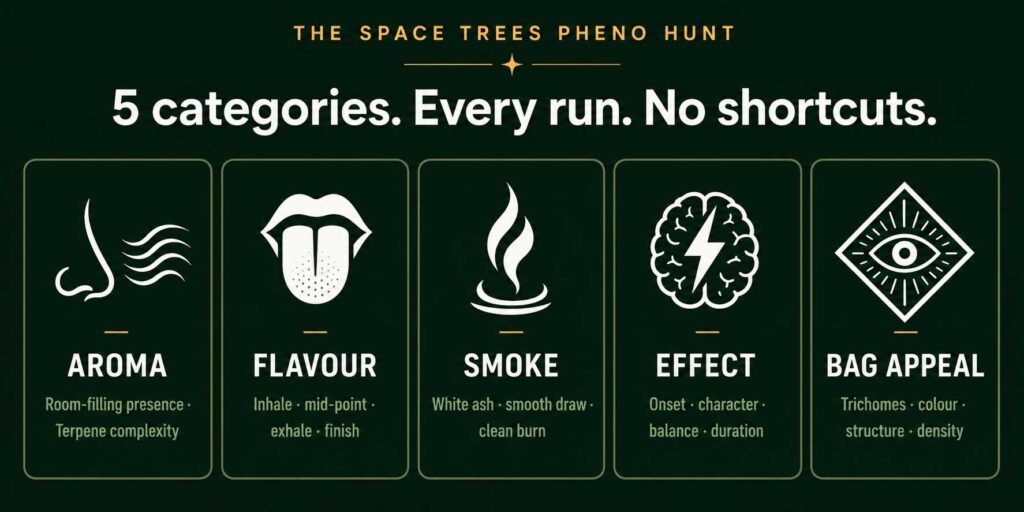
At Space Trees Chiang Mai, every phenotype we grow is evaluated against five consistent criteria before any selection decision is made. These five categories form the foundation of our cannabis pheno hunting methodology — and they are the same five criteria our customers use when they join our tasting sessions.
1. Aroma
The nose is the first and most instinctive evaluation criterion in cannabis pheno hunting. A great pheno announces itself before you even open the jar fully — a room-filling, complex wave of terpenes that is immediately distinctive and consistent with the genetic profile.
We evaluate aroma at three points: during the grow (as a predictor), immediately post-cure (peak terpene expression), and after 30 days of storage (terpene stability over time). A pheno whose terpenes fade quickly is less valuable than one that holds its nose through the full shelf life.
What we look for: Room-filling presence, complexity that develops as the flower warms, distinctiveness from other cultivars on the menu, and fidelity to the genetic promise of the strain.
2. Flavour
Aroma and flavour are related but distinct in cannabis pheno hunting. A pheno that smells extraordinary does not always taste extraordinary — and the reverse is also true. We evaluate flavour across the full consumption experience: the inhale character, the mid-point complexity, the exhale note, and the lingering finish on the palate.
White ash on the exhale is one of the most reliable indicators of a well-grown, properly cured plant — not necessarily of genetic superiority, but of cultivation quality. In our pheno hunts, grey or black ash triggers a review of the grow rather than a rejection of the pheno.
What we look for: Flavour that matches and extends the aroma, complexity across the full consumption experience, clean smooth draw, and a distinctive finish that lingers.
3. Smoke
Smokeability is the evaluation category that separates growing quality from genetic quality in cannabis pheno hunting. A great pheno grown poorly will smoke rough. A mediocre pheno grown in living soil will smoke cleaner than most.
In our pheno hunt sessions we evaluate each sample under the same conditions — same consumption method, same session length, same temperature — to ensure the comparison is fair and the variables are controlled.
What we look for: Smooth, clean draw with no harshness or irritation, even burn rate, white ash, and a smoke density and texture that reflects a properly cured, full-terpene flower.
4. Effect
The effect evaluation in cannabis pheno hunting is the most subjective — but also the most important. This is what the customer experiences. A pheno that smells and tastes extraordinary but produces a flat, undifferentiated, or unpleasant high does not make the menu.
We evaluate effect across the full duration of the experience — onset character and speed, the quality of the primary phase, the transition, the depth and duration of the settled high, and the comedown. We note whether the effect matches the genetic profile and whether it is distinctive enough to earn a permanent place on the menu.
What we look for: Clean, well-defined onset, an effect character that is distinctive and consistent with the genetics, satisfying duration, and a profile that meets a genuine consumer need on the menu.
5. Bag Appeal
Bag appeal is the visual dimension of cannabis pheno hunting — and while it is the last of our five criteria, it matters more than some growers admit. A strain that looks extraordinary on the shelf communicates quality before the jar is even opened. Trichome density, bud structure, colour expression, and overall visual presentation are all evaluated.
In living soil cultivation, bag appeal and terpene quality are often directly linked — the same biological processes that produce exceptional trichome coverage also support the richest terpene expression. A visually spectacular pheno in living soil is almost always a terpene-rich one.
What we look for: Dense trichome coverage with clear, full resin heads, vivid and expressive colour (greens, purples, oranges), tight compact structure with good density, and an overall visual presentation that communicates quality before the first sniff.
The Pheno Hunting Process Step by Step
A full cannabis pheno hunting run at Space Trees follows a structured sequence:
Stage 1 — Seed Selection Source genetics from trusted breeders. Review the documented parent genetics, target phenotype characteristics, and any published grow data. Select a batch size appropriate to the strain’s phenotypic variation — typically 10–20 seeds minimum.
Stage 2 — Germination and Early Veg Germinate all seeds simultaneously under identical conditions. During early vegetative growth, begin making preliminary observations — vigour, node spacing, leaf structure, early resin development, and the first terpene signatures emerging on the stem.
Stage 3 — Full Vegetative Growth As plants develop, begin more detailed documentation. Photograph each plant at weekly intervals. Run hands along the stems to assess early terpene expression. Note growth pattern, lateral branching, and any signs of unusual or exceptional development. Begin eliminating obvious underperformers.
Stage 4 — Flower Flip all remaining plants to 12/12 simultaneously. During flowering, the phenotypic differences become dramatic — bud structure, resin production, colour expression, and aroma all diverge significantly between individuals. This is where the hunt becomes exciting.
Stage 5 — Harvest and Cure Harvest all plants at their individual optimal window — not all simultaneously, as different phenos may finish at different rates. Cure each plant separately, labelled and logged. Allow minimum 28 days cure before evaluation — the Space Trees 14/28 Standard applies to pheno hunt samples as it does to all menu product.
Stage 6 — Blind Evaluation Evaluate all phenos blind — samples labelled only with a number, with the genetic identity revealed after scoring is complete. This removes bias and ensures the evaluation reflects genuine quality rather than expectation. Score each sample across the five categories.
Stage 7 — Selection and Preservation Identify the keeper — the pheno that scored highest across the five categories as a whole. Clone the mother plant immediately. Store backup clones. Begin the documentation process that will inform the strain blog, menu listing, and long-term cultivation programme.
What Makes a Keeper?
In cannabis pheno hunting, a keeper is not necessarily the plant that scored highest in any single category. A pheno that is exceptional in aroma but mediocre in effect is not a keeper. A pheno that has outstanding bag appeal but a forgettable flavour is not a keeper.
A keeper is the plant that achieves the highest combined score across all five categories — particularly when its profile fills a genuine gap on the existing menu. The best keepers are the ones that are immediately distinctive from everything else already in the mother plant library.
At Space Trees, we also consider menu context — what we already have on offer and what a new pheno adds to the overall range. A third gassy indica-dominant hybrid, however exceptional, may be less valuable to our customers than a distinctive balanced hybrid or a uniquely flavoured sativa-leaning pheno that completes the menu’s breadth.
Famous Phenos Found Through the Hunt
The history of modern cannabis is fundamentally a history of exceptional cannabis pheno hunting:
RS-11 (Rainbow Sherbet #11) — Found by Deo Farms in Deep East Oakland through a Pink Guava × OZK cross. The #11 designation tells you it was the eleventh plant evaluated in that run. The Wizard Trees cut of RS-11 — the mother behind our Rainbow Marker strain — is itself a specific pheno selected from RS-11 genetics for its exceptional terpene expression. A pheno of a pheno.
Permanent Marker — JBeezy of Seed Junky Genetics and Doja Pak spent considerable time selecting the Permanent Marker cut from the Biscotti × Jealousy × Sherb Bx1 cross before releasing it through Doja Exclusive. The result became Leafly Strain of the Year 2023.
MAC (Miracle Alien Cookies) — Discovered by Capulator through an accidental cross, then refined through extensive cannabis pheno hunting to produce one of the most celebrated genetics of the modern era. The MAC1 cut — the most sought-after pheno of MAC — remains one of the most cloned genetics in North American cannabis.
Pheno Hunting at Space Trees Thailand
Cannabis pheno hunting at Space Trees Chiang Mai is a continuous, year-round programme. When new genetics arrive, they go into the hunt. When a run produces a standout individual, it enters the mother plant library. When the library needs refreshing — when a cut has been in heavy rotation and we want to introduce something new — we run a new batch.
Our current menu reflects several years of accumulated pheno hunting — each strain representing a keeper that was selected from a batch, evaluated against the five categories, and preserved because it earned its place. The Wizard Trees RS-11 cut behind our Rainbow Marker. The Permanent Marker mother that produces one of our most requested strains. The Mountaintop Mintz pheno selected for its extraordinary terpinolene expression.
For the full story behind each strain on the menu, browse our Strains and Products blog.
For more on how living soil enhances the terpene expression that makes cannabis pheno hunting meaningful, read: What Is Living Soil Cannabis?
Join the Hunt — Customer Tasting Sessions
Cannabis pheno hunting at Space Trees is not just something that happens in the grow room. When we run a new genetics batch and reach the evaluation stage, we invite our community to join the hunt.
Customer tasting sessions give members of our Chiang Mai community — regulars, cannabis enthusiasts, and interested visitors — the chance to evaluate pheno hunt samples blind across our five categories and contribute their scores to the selection process. The community helps us find the winners. The winners end up on the menu.
How it works:
- Tasting sessions are announced through our Instagram and in-store
- Participants evaluate 3–5 numbered samples blind across the five categories
- Scores are collected and combined with the Space Trees cultivation team’s evaluation
- The keeper is selected from the combined scoring
- Participants who helped select a keeper that makes the menu are credited when the strain launches
This is cannabis pheno hunting as a community experience — and it is one of the things that makes the Space Trees approach to cultivation genuinely different from any other dispensary in Chiang Mai.
To find out about upcoming pheno hunt sessions, ask our team in-store or follow Space Trees Thailand on Instagram.
Frequently Asked Questions {#faq}
What is cannabis pheno hunting?
Cannabis pheno hunting is the process of growing multiple plants from the same seed batch and selecting the most exceptional individual based on specific evaluation criteria — typically aroma, flavour, smoke quality, effect, and bag appeal. The selected plant becomes a mother plant, preserved through cloning for ongoing cultivation.
How many seeds do you need for a pheno hunt?
Most serious cannabis pheno hunting programmes run a minimum of 10–20 seeds per batch. More seeds provide a larger sample and a higher probability of finding an exceptional individual. Some elite breeders and cultivators run 50–100 seeds when hunting for a keeper in a highly variable cross.
How long does a pheno hunt take?
A full cannabis pheno hunting cycle — from germination through flowering, harvest, cure, and evaluation — typically takes 4–6 months. The cure alone requires a minimum of 28 days before evaluation samples are ready. Patience is one of the most important qualities in any pheno hunter.
What is a keeper pheno?
A keeper pheno is the individual plant selected from a cannabis pheno hunting run as the best expression of the strain’s genetic potential. It is preserved through cloning and becomes the mother plant for all subsequent cultivation of that strain. Famous keeper phenos include RS-11 #11, Permanent Marker, and MAC1.
Can customers participate in pheno hunting at Space Trees?
Yes — Space Trees Chiang Mai runs customer tasting sessions at key points in our pheno hunting programme, inviting the community to evaluate and score samples blind across the five categories. Participants directly influence which phenos make it onto the menu. Ask our team in-store or follow our Instagram for upcoming session announcements.
How does living soil affect pheno hunting outcomes?
Living soil enhances the terpene expression of every plant grown in it — making the differences between phenotypes more pronounced and easier to evaluate. In a living soil pheno hunt, the exceptional phenos express more loudly and the average phenos are easier to identify and eliminate. The hunt produces better keepers in living soil than in synthetic growing environments.
Last updated: 2026 | Written by the Space Trees cultivation team. Sam Walker — cannabis cultivation specialist with 20+ years of experience. For educational purposes.